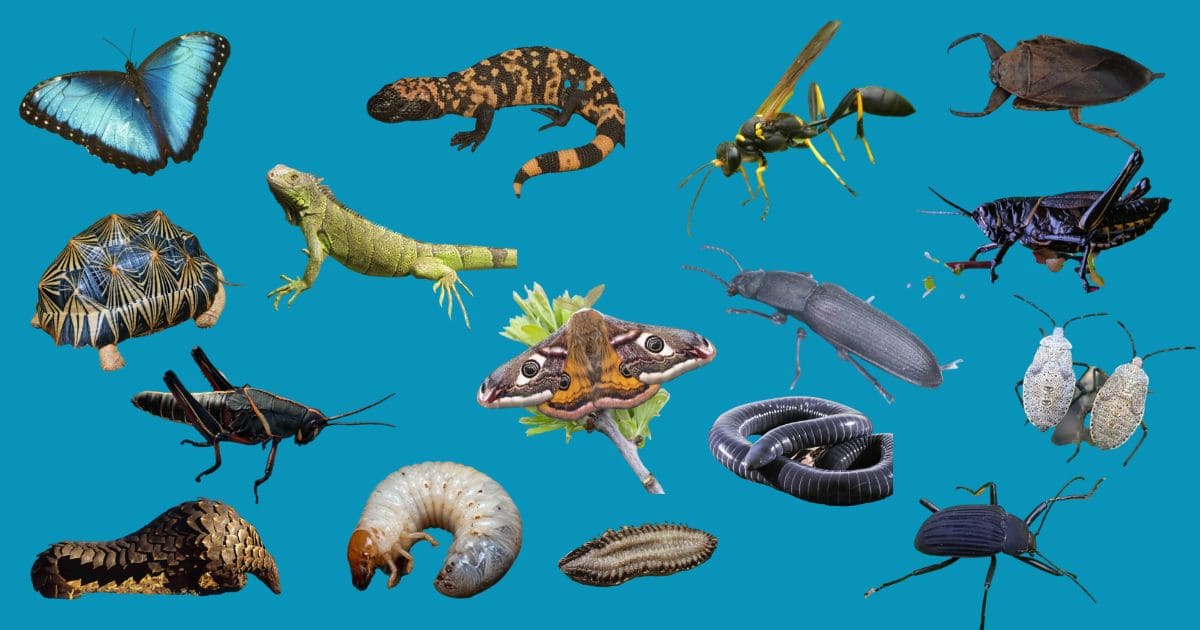
Insects are not a minor branch of animal life. They are the dominant animals on Earth by almost every measurable metric. Over one million insect species have been formally described — more than all other animal species combined. Estimates for undescribed species range from 5 million to 30 million.
Insect biomass exceeds that of all terrestrial vertebrates combined. Every terrestrial ecosystem on Earth depends on insects for pollination, decomposition, nutrient cycling, and as a food source for other animals.
This guide covers what distinguishes insects from other invertebrates, the major insect groups and what defines each, the physical defenses and adaptations insects carry, and why understanding insect biology matters far beyond entomology.
Table of Contents
1. Insects vs. Bugs: The Distinction Most People Miss
“Bug” is used casually to mean any small invertebrate — spiders, centipedes, worms, beetles, flies. Biologically, true bugs are a specific insect order: Hemiptera, defined by piercing mouthparts that inject digestive enzymes and extract liquid from plants or prey. Aphids, cicadas, assassin bugs, shield bugs, and bed bugs are true bugs. Beetles, ants, bees, butterflies, and flies are not bugs in the biological sense — they are insects in other orders.
The distinction between insects and other arthropods is clearer. Insects have three body segments (head, thorax, abdomen), six legs, and typically two pairs of wings. Spiders have two body segments and eight legs — they are arachnids, not insects.
Centipedes and millipedes have many body segments and many legs — they are myriapods. Crabs, shrimp, and woodlice have different segment arrangements — they are crustaceans. All of these are arthropods (animals with exoskeletons and jointed limbs) but only the six-legged, three-segment group are insects.
Understanding this distinction matters practically: the biology, behavior, and control methods for spiders are completely different from those for beetles or flies, even though people treat all of them as interchangeable “bugs.”
2. The Exoskeleton: Armor, Structure, and Constraint
The insect exoskeleton is made of chitin — a polysaccharide polymer that is simultaneously lightweight, flexible in thin sections, and rigid when layered. It serves as skeleton, armor, and waterproofing barrier simultaneously. Without an internal skeleton, the exoskeleton must provide all structural support, which it does effectively at small body sizes.
The exoskeleton’s primary limitation is growth. It cannot expand, so insects must shed it entirely (molting) to grow larger. During the molt, the insect is completely vulnerable — the new exoskeleton beneath the shed one takes hours to harden. Insects that are predated most heavily in their natural environment molt rapidly and hide during the process; social insects use colony members to guard molting individuals.
Some insects carry modified exoskeletal structures — spines, horns, projections — that serve defensive or competitive functions. Species with spiny or spiked exterior surfaces use these projections to make themselves physically difficult to swallow. Our article on spiky animals covers species across multiple animal groups — including insects — that carry exterior spines and projections, and what function these structures serve in each case.
Scales on insect wings — most famously in butterflies and moths (order Lepidoptera) — are modified flat hairs (setae) made of chitin, arranged in overlapping rows like roof tiles. The color and iridescence of butterfly wings comes from the microscopic structure of these scales, not from pigment in most cases.
Removing scales from a butterfly wing leaves a transparent membrane — the wing shape and venation remain but all color disappears. Our article on animals with scales covers scale structures across insects, fish, and reptiles, comparing how scales form and function differently in each group.
3. Metamorphosis: The Most Dramatic Development in the Animal Kingdom
Complete metamorphosis (holometabolism) — used by beetles, flies, bees, ants, butterflies, and moths — involves four completely distinct life stages: egg, larva, pupa, adult. The larva and adult are so physically different that early naturalists classified them as separate species. A caterpillar and a butterfly share identical DNA; their radically different forms are produced by the same genome expressing different gene sets at different developmental stages.
Inside the pupal case, the caterpillar’s body does not simply rearrange — it largely dissolves. Most larval cells break down into a cellular soup, from which adult structures are rebuilt using clusters of cells called imaginal discs that were set aside during larval development and remained dormant until pupation.
The brain does not fully dissolve — some learned behaviors from the larval stage can persist through metamorphosis into the adult, as demonstrated by experiments where larvae were conditioned to avoid certain odors and adults retained this avoidance.
Incomplete metamorphosis (hemimetabolism) — used by grasshoppers, cockroaches, dragonflies, and true bugs — involves three stages: egg, nymph, adult. Nymphs resemble small adults without wings, and wings develop gradually through successive molts rather than forming inside a pupal case. This means the nymph is functional and feeding from the moment it hatches — it does not pass through a non-feeding pupal stage.
4. Insect Defenses: The Full Arsenal
Insects are the primary prey of most terrestrial predators — birds, reptiles, amphibians, spiders, and other insects all feed on them. The defensive strategies insects have evolved as a result are among the most diverse in the animal kingdom.
Chemical defense is widespread and highly varied. Bombardier beetles mix two chemicals (hydroquinones and hydrogen peroxide) in a specialized chamber that produces an explosive reaction, ejecting a boiling caustic spray at 100°C in rapid pulses — up to 500 pulses per second — aimed with accuracy at the predator.
The mechanism can spray in multiple directions and the beetle can survive being swallowed and spray its way back out of a toad’s stomach. Monarch butterfly larvae sequester cardiac glycosides from milkweed plants they eat, storing them in their tissue through metamorphosis — making adult monarchs toxic to most bird predators.
Camouflage in insects exceeds that of almost any other animal group in terms of precision and variety. Stick insects replicate twigs with bark-colored skin, irregular leg posture, and swaying movement that mimics a twig in wind.
Leaf insects replicate not just leaf shape and color but the irregular edges, midrib veins, and brown spots that suggest partial decay — making them visually indistinguishable from dead leaves even on close inspection. Future articles in this category will cover leaf-mimicking insects in dedicated detail.
Mimicry — where a harmless species copies the appearance of a dangerous one — is more common in insects than in any other animal group. Hoverflies copy the yellow-and-black banding of wasps and bees without possessing a sting. Scarlet kingsnake mimics the coloration of the venomous coral snake. Viceroy butterflies mimic monarchs closely enough to receive protection from the monarch’s toxicity reputation without being toxic themselves.
Bioluminescence — the production of light through chemical reactions — is used by fireflies for mate signaling through species-specific flash patterns. Each firefly species produces a unique sequence of flashes; females respond to the correct pattern and males home in on the response.
Some predatory firefly species (genus Photuris) mimic the response patterns of other species to lure and eat the males that approach. Future articles will cover glowing insects and other bioluminescent invertebrates in full detail.
5. Social Insects: The Most Complex Animal Societies Outside Primates
Ants, bees, wasps, and termites form eusocial colonies — the most complex non-human animal societies on Earth. Eusociality requires three conditions: overlapping generations living together, cooperative brood care, and reproductive division of labor (most colony members do not reproduce; only the queen does).
A leafcutter ant colony contains up to 8 million individuals organized into distinct castes based on body size — minim workers that tend fungus gardens, minor workers that cut and carry leaves, major workers that guard the colony, and soldiers with heads comprising 25–30% of body weight that can sever human fingers.
All castes are genetically female; male ants (drones) exist only to mate with new queens and die shortly after. The colony as a whole is sometimes described as a superorganism — the individual ant is roughly analogous to a cell in a body, incapable of survival alone but collectively capable of building complex infrastructure, managing agriculture, and defending territory against much larger animals.
Termite mounds in Africa reach heights of 9 meters and maintain internal temperatures within 1°C of the optimal fungus-growing temperature of 30°C regardless of external temperature swings from 3°C to 42°C. They achieve this through a ventilation system of passages and chimneys that the termites open and close in response to temperature changes — a form of collective thermoregulation with no individual termite having an overview of the whole system.
6. Insects as Ecological Foundations
The ecological functions insects perform are not replaceable by any other animal group at equivalent scale. Pollination of flowering plants — including the majority of human food crops — depends primarily on insects. Decomposition of organic matter on land is dominated by insects and their larvae. Most terrestrial food chains have insects as the primary link between plants and larger animals.
The current documented global decline in insect populations — measured through windshield surveys, light trap counts, and long-term monitoring studies across Europe and North America — represents a potential destabilization of terrestrial ecosystems far more significant than the loss of any large vertebrate species.
A world without elephants is ecologically impoverished; a world without insects is ecologically non-functional for most terrestrial life including humans.
The most dangerous insects to humans are not the largest or most venomous — they are the smallest. Mosquitoes transmit malaria, dengue, yellow fever, Zika, and several other diseases, making them responsible for more human deaths annually than any other animal including other humans.
The Anopheles mosquito alone has altered the course of human history through malaria — affecting the outcomes of military campaigns, shaping settlement patterns, and selecting for genetic variants like sickle cell trait in populations with long exposure. Future articles in this category will cover the most dangerous insect species in dedicated detail.
7. Jumping Insects: Mechanics of the Most Efficient Leapers
Several insect species produce jumps that, relative to body size, far exceed the leaping ability of any vertebrate. The flea jumps 200 times its own body length — the human equivalent of jumping over a 35-story building.
Froghoppers (spittle bugs) jump 70 times their body length with an acceleration of 400 g-force, making them the proportionally most powerful jumpers of any animal measured.
These jumps are not produced by direct muscle contraction — insect muscles cannot contract fast enough to produce the acceleration observed. Instead, insects use a catapult mechanism: muscles slowly compress a spring-like structure (resilin, a rubber-like protein, or hardened cuticle), which is then released by a trigger mechanism in milliseconds.
The energy stored over a slow muscle contraction is released explosively. Future articles in this category will cover jumping insects and the biomechanics behind their extraordinary leaping ability.
Why Insects Matter
Insects appear in almost every other article category: as prey for birds, bats, anteaters, and amphibians covered in the Animal Diet category; as habitat specialists covered in the Animal Habitats category; as convergent evolution examples in the Animal Types category; and as behavioral subjects with communication systems, navigation abilities, and social structures more complex than most vertebrates.
The articles linked in this guide and the future articles in this category provide deeper coverage of individual insect groups — their anatomy, behavior, ecological role, and the specific adaptations that make each group distinctive. Follow the links to whichever topic interests you most.

I have loved animals since I was a kid. I enjoy reading about how animals live, eat, move, and survive. I started Animals Window to share what I learn in a simple and easy way. I write about animal body parts, size, behavior, diet, habitats, and species. My goal is to make animal facts clear and fun for everyone to understand.