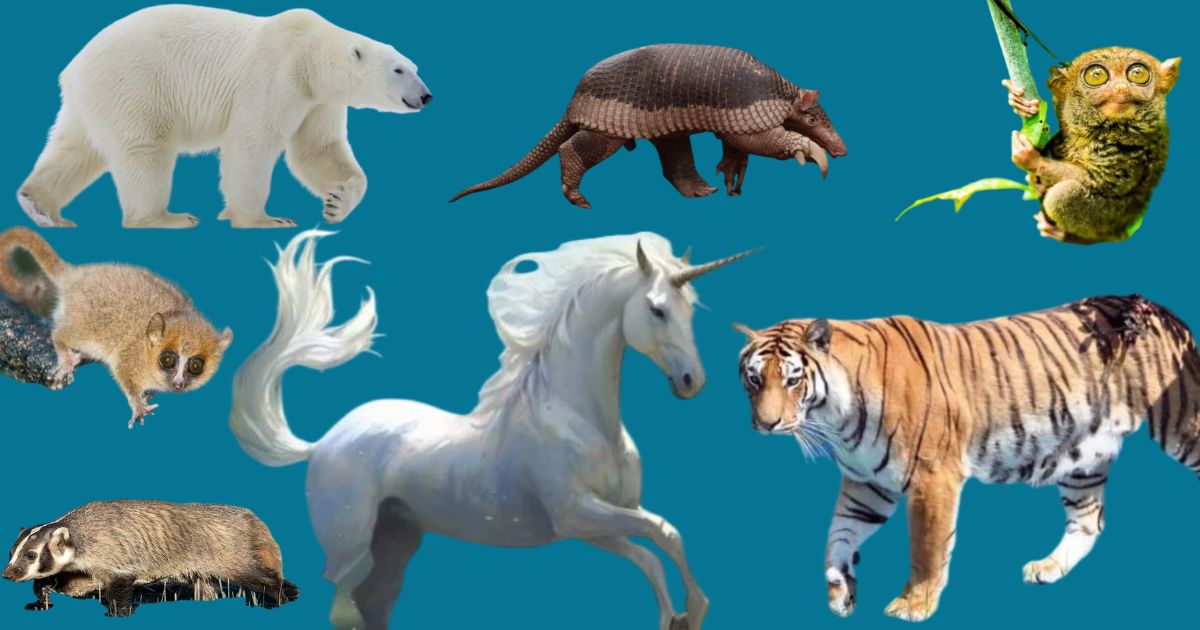
Every animal on Earth carries a body shaped by millions of years of pressure — pressure to survive, hunt, hide, or adapt to conditions that would kill most living things. The result is an astonishing range of physical features: teeth that never stop growing, eyes that see in complete darkness, noses that detect water from miles away, and claws sharp enough to puncture bone.
This guide breaks down the most remarkable animal body features by type — what they are, why they exist, and which animals carry them to the extreme. It is not a list of fun facts. It is a structured look at how physical anatomy directly determines how an animal eats, survives, communicates, and reproduces.
Table of Contents
1. Claws and Nails: Built for Grip, Hunting, or Defense
Claws are among the oldest and most widespread body weapons in the animal kingdom. They serve three primary functions: catching prey, climbing surfaces, and self-defense. The structure, curvature, and material of a claw tells you exactly how an animal lives.
Eagles carry talons with a grip pressure exceeding 400 pounds per square inch — strong enough to crush the spine of a small mammal on contact. The harpy eagle specifically has rear talons the size of grizzly bear claws, used to snatch monkeys from tree canopies mid-flight. In contrast, a sloth’s claws are long and curved not for killing but for hanging — they require almost zero muscle effort to stay locked onto a branch, which is why sloths can sleep suspended upside down for hours.
Animals with retractable claws (most cats) keep them sharp by sheathing them when not in use. Animals with non-retractable claws (dogs, cheetahs) use them like cleats — grip for running, not precision hunting. This one difference in claw mechanics separates ambush predators from pursuit predators.
For a complete breakdown of which species carry the sharpest and most specialized claws, see our detailed guide on animals with sharp claws — including how each species uses them differently in the wild.
2. Eyes: Seeing the World in Completely Different Ways
The human eye has a single forward-facing field of view — roughly 180 degrees. Most animals see the world very differently, and eye size, placement, and structure reveal exactly what an animal prioritizes: spotting threats, tracking fast prey, or navigating in complete darkness.
The tarsier holds the record for largest eyes relative to body size of any mammal. Each eye is as large as its brain, fixed in its skull (it cannot move them), and so powerful it can detect moth-wing movement in near-total darkness. Owls share this trait — fixed eyes, extreme low-light sensitivity, compensated by a neck that rotates 270 degrees.
On the opposite end, the mantis shrimp has 16 types of photoreceptor cells compared to the human 3. It perceives ultraviolet, infrared, and polarized light — colors and light spectrums that are completely invisible to humans. Scientists still do not fully understand how the mantis shrimp processes this visual information.
Prey animals like horses and rabbits have eyes on the sides of their heads, giving them nearly 360-degree vision to detect approaching predators. The trade-off: no depth perception directly in front of them, making them poor judges of distance for precision tasks.
Explore how eye size and structure vary across the animal kingdom in our focused article on animals with big eyes, which covers why certain species evolved oversized eyes and the survival advantage this provides.
3. Noses and Smell Organs: The Underrated Superpower
Smell is the primary sense for most mammals, yet it is the one humans understand least because our own sense of smell is so comparatively weak. A dog has roughly 300 million olfactory receptors versus the human 6 million — meaning the dog’s nose is not just “better,” it operates on an entirely different functional level.
The star-nosed mole carries 22 pink, fleshy appendages around its nostrils. These are not decorative. They contain more than 25,000 minute sensory receptors called Eimer’s organs, making the star-nosed mole the most touch-sensitive animal on Earth. It can identify and consume a food item in 120 milliseconds — faster than the human eye can track.
The elephant’s trunk is simultaneously a nose, a hand, a drinking straw, and a communication tool. It contains 150,000 individual muscle units (no bones) and can lift over 770 pounds, yet is precise enough to pick up a single grape. The olfactory region of an elephant’s brain is proportionally larger than that of any other mammal — they can smell water up to 12 miles away.
Some of the most visually striking nose structures belong to proboscis monkeys, tapirs, and saiga antelopes. We cover the anatomy and function of unusual nasal structures across species in our article on animals with big noses.
4. Shells and External Armor: Protection as a Body Feature
Hard outer coverings — shells, carapaces, scutes — represent one of evolution’s most successful survival strategies. Unlike fur or fat, armor provides passive protection that requires no energy to deploy.
The tortoise shell is not a separate object the animal carries. It is fused directly to the spine and rib cage — the tortoise cannot leave its shell any more than a human can remove their skeleton. The shell has nerve endings and blood vessels running through it; tortoises feel touch through their shell.
The pangolin is the only mammal with scales, made of keratin — the same material as human fingernails. When threatened, it rolls into a tight ball with scales overlapping like roof tiles. Lions have been observed unable to pry open a curled adult pangolin. Pangolin scales are so effective that poaching for their supposed medicinal value (scientifically unfounded) has made them the most trafficked mammal in the world.
Armadillos carry bony plates called osteoderms, embedded in skin rather than attached to skeleton. The three-banded armadillo is the only species that can roll into a complete sealed ball — other armadillos simply crouch. A nautilus shell, unlike the tortoise’s, is not protective armor but a buoyancy device — the animal controls its depth by adjusting gas pressure in the shell’s chambers.
For a detailed look at species that use shells as their primary survival tool, our article on animals with shells covers both land and marine species with the most specialized protective coverings.
5. Flippers and Fins: When Limbs Became Water Tools
Flippers are modified limbs — the same skeletal bones present in a human arm (humerus, radius, ulna, carpals) exist inside a whale’s flipper, just rearranged and encased in a rigid, paddle-shaped structure. This tells us that whales, seals, and dolphins evolved from land-dwelling ancestors whose legs gradually adapted to water.
The leatherback sea turtle has flippers that can span up to 2.7 meters — wider than most humans are tall. These flippers generate the thrust needed to cross entire ocean basins; leatherbacks migrate over 10,000 miles between nesting and feeding grounds. The front flippers provide forward power; the rear flippers steer.
Penguins technically have wings, not flippers — but millions of years of aquatic adaptation have made them useless for flight and exceptional for swimming. Penguin “wings” are rigid, dense, and shaped like hydrofoils, allowing some species to reach swimming speeds of 22 mph underwater.
Seals and sea lions demonstrate the transitional stage clearly — they can still move on land using their flippers, while walruses can rotate their rear flippers forward to walk. Fully aquatic mammals like dolphins have lost rear limbs entirely (vestigial hip bones remain inside the body). Our article on animals with flippers details how different species evolved their aquatic limbs and how swimming mechanics differ between groups.
6. Horns and Antlers: Not the Same Thing
Most people use “horns” and “antlers” interchangeably. They are biologically distinct structures with different growth patterns, compositions, and functions.
Horns are permanent, made of keratin over a bone core, and grow continuously throughout an animal’s life. Both sexes in many species carry them (bison, wildebeest). They are never shed. Antlers are made of bone, grow from the skull on pedicles, are shed and regrown annually, and are carried almost exclusively by male deer species (caribou females being the notable exception).
The narwhal’s tusk is neither horn nor antler — it is a modified canine tooth that grows through the upper lip, spiraling left, reaching up to 10 feet in length. For centuries, narwhal tusks sold in Europe as “unicorn horns” were considered magical artifacts worth more than their weight in gold. The tusk contains millions of nerve endings that may help the narwhal sense water temperature, salinity, or pressure changes.
The pronghorn of North America carries forked horns — unique in that it sheds the outer keratin sheath annually while keeping the bony core. No other animal does this. It is technically neither a true horn nor a true antler. The pronghorn is also the fastest land animal in the Western Hemisphere, a feature entirely unrelated to its horn structure — but notable because it evolved speed to outrun a predator (the American cheetah) that has been extinct for 10,000 years.
Species that carry a single horn rather than a pair are rarer and ecologically distinct. Our article on animals with one horn covers both true single-horned species and those with asymmetrical horn growth.
7. Tails: Balance, Communication, and Survival
A tail’s function varies so dramatically across species that it is almost misleading to group them under one term. A rattlesnake’s tail is a warning instrument. A kangaroo’s tail is a fifth limb used for balance and slow-speed locomotion. A peacock’s tail is a sexual display structure that costs the bird significant energy to grow and carry. A dog’s tail communicates emotional state to other dogs and to humans.
The axolotl can regrow a lost tail — including the spinal cord, blood vessels, and muscle — a regenerative ability no mammal possesses. The regenerated tail is functionally identical to the original.
Some animals have lost tails entirely through evolution: great apes (humans included), some bird species, and certain island-dwelling populations of normally-tailed mammals where tail loss provided no survival disadvantage. The Manx cat is a domestic breed where a natural genetic mutation eliminated the tail, yet the cat functions normally — demonstrating that for some species, the tail’s original functions have been replaced by other adaptations.
8. Whiskers: Sensory Tools, Not Just Facial Hair
Whiskers (vibrissae) are not regular hair. They are deeply embedded in tissue rich with nerve endings and blood vessels, connected directly to the sensory cortex of the brain. When an object disturbs air currents near a whisker, the vibration travels to the brain as precise spatial information — essentially a touch-sense radar system.
Cats use whiskers to judge whether their body will fit through a gap before attempting to pass through it. Whisker width generally matches shoulder width. A cat that loses its whiskers becomes noticeably disoriented in low light and narrow spaces.
Harbor seals can track the hydrodynamic trail left by a fish up to 35 seconds after the fish has swum past — using whiskers alone, in complete darkness, following the water disturbance the fish left behind. This is more precise than any human-engineered sonar at equivalent scale.
The walrus uses whiskers to feel along the seafloor for clams, which it cannot see in murky water. The whisker-to-brain connection in walruses is so developed that some researchers classify walrus whiskers as a primary sense organ, equivalent in importance to eyes or ears. See how whiskers function differently across species in our article on animals with whiskers.
9. Necks: Reach, Display, and Combat
Neck length is rarely about eating alone. Giraffes are the obvious example — a neck that reaches 6 feet in length allows access to acacia leaves above competing browsers. But research shows male giraffes also use their necks as weapons in “necking” combat — swinging their heads as clubs to strike rivals. Males with longer, heavier necks win more fights and father more offspring, which means sexual selection, not just food access, drives neck length in giraffes.
The snake’s “neck” is its entire body — lacking limbs, the snake’s spine is one continuous flexible structure with up to 400 vertebrae. This gives snakes the ability to constrict, tunnel, swim, and climb using a body plan that mammals cannot replicate.
Flamingos have an S-curved neck with 19 cervical vertebrae (humans have 7), which allows them to flip their head upside down to filter-feed — their beak is specifically designed to work inverted. A flamingo feeding right-side up cannot feed at all. Our article on animals with long necks covers the full range of neck adaptations and why each evolved the way it did.
10. Brains: Size Is Not the Point
Brain size relative to body size (encephalization quotient) is a better measure of cognitive potential than raw brain weight — but even that has limits. The sperm whale has the largest brain of any animal ever measured (17 pounds), yet displays problem-solving ability roughly comparable to dolphins, whose brains are far smaller. The octopus has two-thirds of its neurons distributed through its arms, not its central brain — meaning each arm processes information semi-independently.
The animal with the smallest brain relative to body size is not the one most people guess. Our article on animals with the smallest brain covers which species have the least neural tissue and how they still manage complex survival behaviors without it.
11. Hearing: The Sense That Outperforms All Others
The human hearing range is 20 Hz to 20,000 Hz. Most animals operate well beyond this. Bats echolocate at frequencies up to 200,000 Hz — emitting sound pulses and reading returning echoes to build a three-dimensional map of their environment accurate enough to catch a moth in total darkness while flying at speed.
Elephants communicate via infrasound — frequencies below 20 Hz that humans cannot hear — which travel through ground vibrations over distances exceeding 6 miles. Elephants “hear” with their feet as much as with their ears, detecting vibrations through the sensitive skin of their soles and through bones in their legs that conduct sound to the inner ear.
The greater wax moth can detect frequencies up to 300,000 Hz — the highest confirmed hearing range of any animal on Earth. This evolved specifically as a counter-defense against bat echolocation — the moth detects the bat’s sonar before the bat detects the moth, giving it time to perform evasive maneuvers. Our article on animals with the best hearing ranks and explains the top hearing specialists across mammals, insects, and birds.
12. Opposable Thumbs: Not Just a Human Trait
Opposable thumbs — the ability to press the thumb against the other fingers to grip objects — exist in several primate species, some birds, and even one marsupial. The key difference between species lies in precision: human thumbs allow tool use requiring fine motor control; chimpanzee thumbs allow grip and basic tool use; koala thumbs (two on each hand, two toes fused on each foot) are used primarily for gripping eucalyptus branches.
The giant panda has a “false thumb” — an enlarged wrist bone (the radial sesamoid) that functions like a sixth digit, allowing it to grip bamboo stalks. This is not a true thumb and does not contain the same bone structure, but it performs the same mechanical function. Evolution produced the same tool through a different anatomical path.
For the full list of animals that grip, hold, and manipulate objects using thumb-like structures, see our article on animals with opposable thumbs.
Why Animal Body Features Matter Beyond Biology
Understanding animal body parts is not just about trivia. It shapes how conservation decisions are made (protecting the habitat that makes a specific body feature functional), how engineers design tools (biomimicry — from Velcro copied from burdock burrs to swimsuit fabric copied from shark skin), and how veterinary medicine approaches treatment (a pangolin’s scale is living tissue, not dead armor).
Each article linked in this guide goes deeper into one specific body feature — covering the top species, the anatomy behind it, and the evolutionary reason it exists. Start with whichever feature interests you most, and follow the internal links from there.

I have loved animals since I was a kid. I enjoy reading about how animals live, eat, move, and survive. I started Animals Window to share what I learn in a simple and easy way. I write about animal body parts, size, behavior, diet, habitats, and species. My goal is to make animal facts clear and fun for everyone to understand.