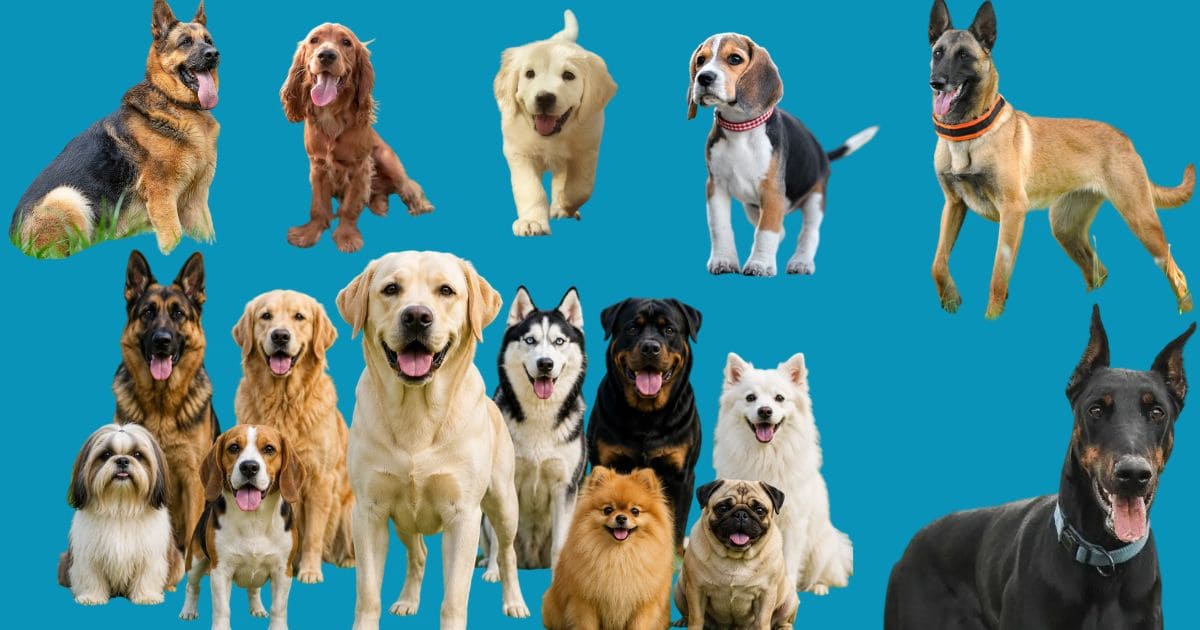
Dogs are the only large carnivore fully domesticated by humans — a relationship that began approximately 15,000 to 40,000 years ago and has produced more physical and behavioral diversity in a single species than natural selection has produced in most entire genera.
From the 1.5-kg Chihuahua to the 90-kg Great Dane, from the hairless Xoloitzcuintli to the double-coated Siberian Husky, every dog on Earth shares the same scientific name — Canis lupus familiaris — a subspecies of the grey wolf.
This guide covers the biology that connects dogs to their wild ancestors, the anatomy that sets different breeds apart, the intelligence that makes dogs uniquely suited to human partnership, and the specific physical traits and behaviors that the articles in this category examine in depth.
Table of Contents
1. The Wolf Connection: What Domestication Actually Changed
Dogs did not descend from modern grey wolves — both dogs and modern wolves share a common ancestor that is now extinct. The split happened somewhere between 15,000 and 40,000 years ago, with recent genetic analysis pointing toward a single domestication event in either Europe or Asia rather than multiple independent events.
What changed during domestication is not primarily anatomy but neurology and social behavior. Dogs develop the ability to read human social and communicative cues — pointing, gaze direction, facial expression — at a level that wolves raised by humans from birth cannot match.
This ability is not learned; dog puppies show it from the earliest age they can be tested. Wolves, despite higher performance on some problem-solving tasks, systematically fail at following human social cues that even 9-week-old puppies handle correctly.
Dogs have also lost behavioral independence that wolves retain. A wolf separated from its pack investigates problems alone and is highly motivated by self-directed problem-solving. A dog in the same situation looks to humans for guidance — a trait that is simultaneously why dogs are so useful as working partners and why isolated dogs often develop anxiety-based behavioral problems that wolves do not.
The mating behavior of dogs’ closest wild relatives is covered in our article on whether wolves mate for life — which explains how wolf pair bonds work, how long they last, and what happens to wolf pack structure when an alpha pair separates, providing context for how profoundly domestic dogs have diverged from this social structure since domestication.
2. Dog Anatomy: The Most Physically Diverse Species on Earth
No other single species produces the range of body sizes, skull shapes, leg proportions, ear types, and coat textures that domestic dogs do. This diversity is the direct result of artificial selection — humans selecting for specific traits across hundreds of generations with far greater intensity than natural selection typically allows.
Skull shape (technically called cranial morphology) varies more across dog breeds than it varies across the entire order Carnivora in the wild. A brachycephalic breed (short-faced: Bulldog, Pug, French Bulldog) has a skull shape so compressed that it causes breathing difficulties in most individuals — a shape no wolf ancestor had and no wild canid has ever evolved toward, because it reduces survival. It exists only because it was selected by humans.
Leg length relative to body length varies from the near-normal proportions of a German Shepherd to the extreme dwarfism (chondrodysplasia) of a Dachshund or Basset Hound — short legs produced by a retroviral sequence inserted into the genome that interferes with bone development.
This same mutation has been identified in multiple short-legged breeds, suggesting it was either introduced once and spread through selective breeding or reintroduced multiple times from the same original source.
Coat types — single-coated, double-coated, wire-haired, curly, corded (as in the Puli and Komondor), and hairless — represent different combinations of hair growth genes. Double coats provide insulation for cold-climate breeds; single coats shed less but offer reduced insulation.
Hairless breeds carry a mutation in the FOXI3 gene that also affects tooth development — most hairless dog breeds have fewer teeth and differently shaped teeth than coated breeds as a side effect of the same gene.
3. Webbed Feet: Why Some Dogs Are Built for Water
Most dogs have a small degree of webbing between their toes — connective tissue that is present in all dog embryos and is fully retained in some breeds while receding in others. Breeds developed specifically for water work — retrieving waterfowl, swimming nets, or water rescue — retain the fullest webbing, which functions as a paddle surface during swimming.
Labrador Retrievers, Portuguese Water Dogs, Nova Scotia Duck Tolling Retrievers, and Newfoundlands are among the most webbed breeds. The Newfoundland’s webbed feet, combined with a water-resistant double coat and an exceptionally powerful swimming stroke, made it the standard rescue dog on fishing vessels in North Atlantic conditions. Historical records of Newfoundlands pulling drowning sailors from rough surf date to the 18th century.
Our article on dogs with webbed feet covers every major breed with significant toe webbing — what their webbing looks like, how it developed through selective breeding, how it affects swimming mechanics, and why some breeds considered “water dogs” actually have less webbing than breeds not typically associated with swimming.
4. Dog Intelligence: Instinctive, Adaptive, and Working
Dog intelligence is not a single trait — it is a set of distinct cognitive abilities that were selectively bred for in different directions depending on the breed’s working purpose.
Psychologist Stanley Coren identified three types of dog intelligence in his research: instinctive intelligence (what the dog was bred to do), adaptive intelligence (problem-solving from experience), and working and obedience intelligence (following human commands).
Border Collies consistently rank highest in working and obedience intelligence — they can learn a new command in under five repetitions and obey it reliably on the first attempt at 95% accuracy. But herding breeds also show extreme sensitivity to subtle human body language because herding requires anticipating human intent from minimal cues, a trait that makes them highly responsive partners but also prone to anxiety in unpredictable environments.
Scent hounds — Bloodhounds, Beagles, Basset Hounds — score lower on obedience intelligence tests because they were bred to follow a scent trail to the exclusion of other input, including commands from handlers. They are not less intelligent; they have a different cognitive priority hierarchy.
A Bloodhound following a trail is performing a cognitive task of extraordinary complexity — tracking a scent through overlapping trails, across water obstacles, and through areas where the target doubled back — that no Border Collie could match.
Working dogs in police, military, search and rescue, and medical detection roles demonstrate that adaptive intelligence in dogs extends well beyond what was originally selected for. Dogs have been trained to detect cancer cells, predict epileptic seizures, detect low blood sugar in diabetic patients, and identify COVID-19 infections with accuracy comparable to laboratory testing — none of which existed as selection pressures during any breed’s development.
5. Breed Appearance: Dogs That Look Like Other Animals
The extreme physical variation in dog breeds has produced several that, at first glance, do not look like dogs at all. This striking visual similarity to other animals has made these breeds enormously popular — and has driven a specific set of keywords where people actively search for dogs that resemble particular wild animals.
Dogs that resemble wolves — Siberian Huskies, Alaskan Malamutes, Czechoslovakian Wolfdogs, Tamaskan Dogs, and Saarloos Wolfdogs — are among the most searched breed categories. The visual resemblance is real: their skull proportions, coat coloring, and upright ears closely replicate the wolf body plan that selective breeding has moved most breeds away from.
Some of these breeds (Czechoslovakian Wolfdog, Saarloos Wolfdog) were deliberately created through wolf-dog hybridization programs in the 20th century, giving them a genetic as well as visual connection to wild wolves. Future articles in this category will cover wolf-like dog breeds in dedicated detail.
Dogs that resemble bears — Chow Chows, Samoyeds, Tibetan Mastiffs, and Pomeranians — achieve the resemblance primarily through extreme coat density. A Tibetan Mastiff’s coat is thick enough to provide full winter insulation in Himalayan conditions, and the overall silhouette at a distance is genuinely bear-like.
The Chow Chow adds an unusual characteristic: a blue-black tongue, shared with only a handful of other dog breeds and with certain bear species. Future articles will cover bear-resembling dog breeds specifically.
Dogs that resemble foxes — Shiba Inus, Akitas, Fennec-like Chihuahuas, and several Spitz-type breeds — share the pointed muzzle, upright ears, and dense reddish-gold coat that characterize foxes. The Shiba Inu’s resemblance is close enough that the breed has become widely used in fox-related internet culture despite being a dog. Future articles will cover fox-like dog breeds in depth.
Dogs that resemble cats in temperament and physical independence — certain sighthounds, the Basenji, the Shiba Inu — have been described as “cat-like dogs” because of their grooming behavior, independence from owner attention, and selective responsiveness to commands.
The comparison is behavioral rather than purely visual, but the search interest is high. Future articles will cover breeds most often compared to cats.
6. Dog Communication: The Full Signal Set
Dogs communicate through a minimum of four channels simultaneously: vocalizations, body posture, facial expression, and olfactory signals. Most human dog owners focus almost entirely on the first — barking, whining, growling — while missing the more precise and more nuanced information in the other three channels.
Tail position and movement encode specific states with a precision that vocalizations do not. A tail wagging to the right (from the dog’s perspective) indicates positive approach motivation; wagging to the left indicates withdrawal tendency — a distinction measurable in dogs and in the dogs that observe them, with dogs showing higher heart rate and more vigilant posture in response to left-biased wags from unfamiliar dogs.
This left-right asymmetry in tail movement tracks asymmetries in emotional processing across the dog’s two brain hemispheres.
Ear position, combined with eye muscle tension and mouth shape, creates what canine behavior researchers call “facial action units” — discrete muscle movements that convey emotional state.
Dogs have developed facial muscles specifically for communication with humans that wolves lack — the levator anguli oculi medialis muscle, which produces the “puppy eyes” expression by raising the inner brow, is present and highly developed in dogs but absent or vestigial in wolves.
This muscle evolved in domestic dogs, not before domestication, suggesting humans selected for it because the expression triggers caregiving responses.
Olfactory communication — through urine marking, anal gland secretions, and scent glands in paws — conveys information about sex, reproductive status, diet, health, and individual identity that persists at a location long after the dog that left it has moved on.
A dog investigating a urine mark is reading a detailed message; lifting and overmarking is a specific response to the information contained in that message, not simply territory-claiming in the simplified sense it is often described as.
7. Ferrets: The Other Pet in This Category
Ferrets are not dogs — they are mustelids, more closely related to weasels, otters, and wolverines than to any canid. They appear in this category because the site’s Dogs category covers pet-focused content that does not yet have its own dedicated sub-category, and ferrets are among the most commonly kept exotic pets with a dedicated owner community generating significant search volume.
Ferrets (Mustela putorius furo) were domesticated from the European polecat approximately 2,500 years ago, making them one of the oldest domestic animals still kept primarily as working animals — originally used for rabbit hunting (ferreting), they are now kept almost exclusively as pets in most of the world.
They sleep 18–20 hours per day and spend their waking hours in intense, highly social activity — a sleep-wake pattern driven by their extreme metabolic rate, which requires frequent feeding to sustain.
Their close wild relatives and the animals most often compared to ferrets are covered in our article on animals like ferrets, which identifies the mustelids and non-mustelids that share the ferret’s body plan and behavioral characteristics.
Future articles in this category will cover ferret names in depth — the naming conventions ferret owners use, which names work best for individual versus paired ferrets, and the names most commonly chosen for different coat colors. Giant ferret breeds (larger mustelid species sometimes kept as pets in regions where ferrets are restricted) will also be covered in a dedicated article.
8. The Dog-Human Partnership: What Makes It Biologically Unique
The relationship between dogs and humans is not simply a domestication story — it is a 15,000-year-long co-evolutionary process that has changed both species. Humans selected dogs for traits that made them more useful partners; dogs that formed stronger social bonds with humans, read human signals better, and showed less fear of human proximity survived and reproduced more successfully than those that did not.
The result is a non-human animal that has developed the most sophisticated cross-species social communication in the animal kingdom. Dogs follow human pointing gestures better than chimpanzees. They track human gaze in situations where other domesticated animals do not.
They distinguish between familiar and unfamiliar humans before their eyes are even fully developed. They monitor human emotional states and adjust their behavior in response to human stress levels in ways that have produced measurable health effects in the humans they live with.
Understanding dogs as the biological product of this specific partnership — rather than as small wolves, as childlike dependents, or as animals operating purely on instinct — changes how owners approach training, health, and behavior.
The articles in this category cover the specific traits, anatomy, comparisons, and questions that come up when people look at what dogs actually are and how they actually work.

I have loved animals since I was a kid. I enjoy reading about how animals live, eat, move, and survive. I started Animals Window to share what I learn in a simple and easy way. I write about animal body parts, size, behavior, diet, habitats, and species. My goal is to make animal facts clear and fun for everyone to understand.