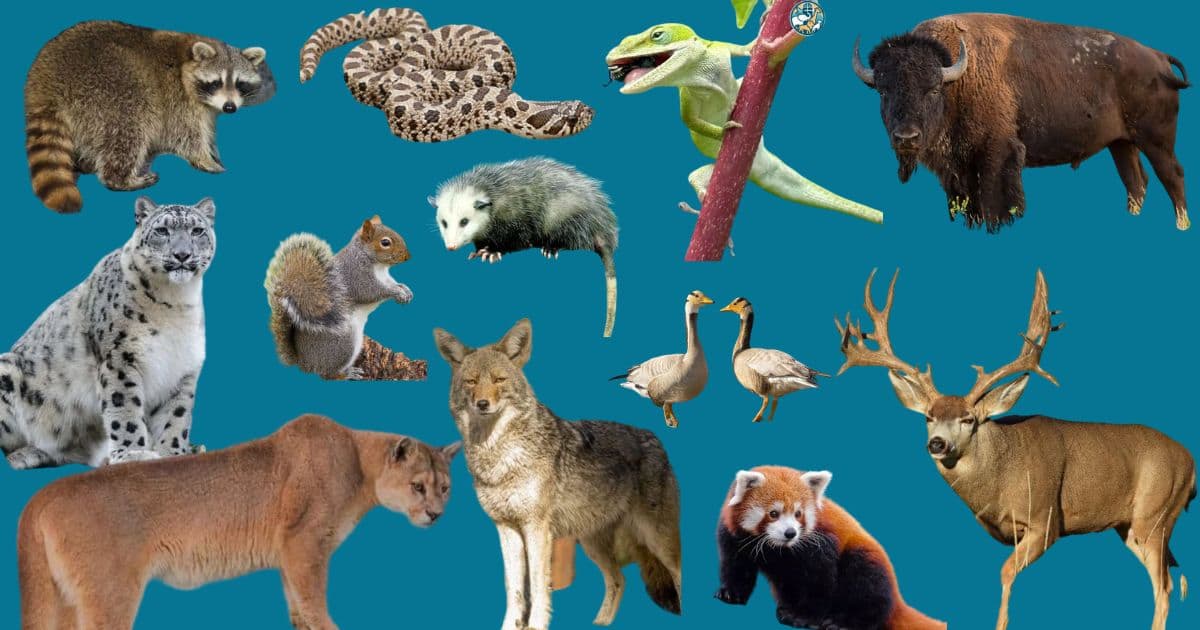
Habitat is not simply where an animal happens to be found. It is the specific combination of temperature range, food availability, shelter type, moisture level, and competing species that an animal’s body and behavior have been shaped to exploit over thousands of generations.
Move an animal out of its habitat and the mismatch shows immediately — not just in survival rate but in behavior, reproduction, and physical condition.
This guide covers the major habitat types on Earth, what defines each one ecologically, and which animals are most precisely adapted to each environment — including some surprising examples of species that have adapted to environments created entirely by humans.
Table of Contents
1. Grasslands and Prairies: Open Space, High Visibility, No Hiding
Grasslands cover roughly 40% of Earth’s land surface and support more large mammal biomass than any other terrestrial habitat. The defining ecological challenge of grassland life is exposure — there is nowhere to hide from predators, nowhere to shelter from weather, and food is distributed across vast horizontal distances rather than concentrated vertically as in forests.
Animals that succeed in grasslands have solved this exposure problem in one of three ways: speed (allowing escape from predators across open ground), burrowing (creating shelter below the surface), or size (becoming large enough that most predators cannot threaten them).
The convergent evolution of speed in grassland animals across different continents is striking — pronghorns in North America, cheetahs and springboks in Africa, and saiga antelopes in Central Asia all independently evolved the capacity for sustained high-speed running in response to the same selective pressure: open terrain with no cover.
North American prairies once supported bison herds estimated at 30–60 million animals moving in coordinated seasonal patterns across the entire continent’s mid-section. The prairie ecosystem is more complex than its flat surface suggests — it includes dozens of grass species with different root depths, underground fungal networks connecting plant root systems, and soil communities of invertebrates that process more organic matter per hectare than the visible surface vegetation.
Our article on prairie animals covers the species most characteristic of grassland ecosystems and the specific adaptations each carries for open-terrain survival.
2. Urban and Human-Modified Habitats: Animals That Moved In
Human settlements have created entirely new habitat types that did not exist before agriculture and construction — and dozens of species have adapted to exploit them within historical timescales. This is one of the fastest examples of ecological adaptation documented in modern biology.
Attics, wall cavities, and roof spaces replicate the thermal environment of caves and tree hollows — dark, thermally stable, protected from weather and predators, with a single defensible entrance. Several mammal and bird species have abandoned natural shelter entirely in favor of human structures because these artificial versions are more reliable and warmer than anything available in their original habitat range.
Raccoons in North American cities have measurably higher problem-solving ability than their rural counterparts — urban raccoons consistently outperform rural ones on cognitive tests involving novel mechanisms for accessing food.
This is active, measurable adaptation occurring within a few decades rather than thousands of years, driven by the selection pressure of navigating human security systems to access reliable urban food sources. The animals that could not figure out trash cans, locks, and latches left fewer offspring than those that could.
Peregrine falcons — the fastest animals on Earth, capable of reaching 390 km/h in a stoop — have established breeding populations in most major cities worldwide. City skyscrapers replicate cliff faces almost exactly: tall vertical surfaces with ledge projections at multiple heights, with unobstructed sightlines over open areas (plazas, parks, rivers) where prey congregates.
Urban pigeon populations provide a reliable, year-round prey base that wild peregrines in their natural cliff habitats cannot match. Our article on animals that live in attics covers the full range of species that colonize human structures and the specific features of buildings each species uses.
3. High-Altitude Environments: Life Above the Tree Line
High-altitude habitats — above 3,500 meters — present a combination of challenges that most animals cannot survive: reduced oxygen partial pressure, extreme temperature swings between day and night, intense UV radiation, and seasonal food scarcity so severe that most species must either migrate or enter dormancy.
Animals that live permanently at high altitude share several physiological traits regardless of their evolutionary background. Larger lung capacity relative to body size. Higher red blood cell density for oxygen transport.
Wider blood vessels to maintain circulation in cold temperatures. A hemoglobin structure that binds oxygen more efficiently at lower partial pressures. The yak, the snow leopard, the bar-headed goose, and the pika have all arrived at these same solutions through completely independent evolutionary paths.
The bar-headed goose crosses the Himalayas during migration — flying over peaks exceeding 7,000 meters where oxygen levels are roughly 30% of those at sea level, at air temperatures approaching -50°C. It does this in a single non-stop flight of approximately 8 hours, fueled by fat reserves accumulated at lower altitudes. Its hemoglobin has a single amino acid substitution that dramatically increases oxygen affinity compared to closely related geese that do not migrate at high altitude.
Mount Everest and the surrounding Himalayas support more animal life than most people expect — including species that live permanently above 5,000 meters. Our article on animals on Mount Everest covers which species have been documented at extreme elevations, how high each has been recorded, and the physiological adaptations that make permanent high-altitude life possible.
4. Captive and Controlled Environments: The Terrarium Habitat
Terrariums — enclosed glass or acrylic environments that replicate specific habitat conditions — represent a distinct category of animal habitat that exists because certain species adapt well to captive conditions while retaining their natural behaviors.
The animals best suited to terrariums share specific traits: small body size (allowing adequate space in a manageable enclosure), tolerance for stable rather than varying conditions (since terrariums cannot replicate seasonal changes in full), low social complexity (most terrarium species are solitary in the wild), and a natural habitat with clearly replicable parameters (specific humidity, temperature gradient, substrate type, UV exposure).
Leopard geckos have become one of the most widely kept terrarium animals because their natural habitat — the rocky, arid scrublands of Afghanistan, Pakistan, and northwestern India — is straightforward to replicate: a temperature gradient between 25°C and 35°C, low humidity, flat rocks for hiding and thermoregulation, and a substrate that retains heat.
In captivity they live significantly longer than in the wild (15–20 years versus 3–5 years) because the primary mortality factors in their natural habitat — predation and drought — are eliminated.
Dart frogs kept in terrariums require the opposite conditions — high humidity, live plant cover, gentle water features, and UVB lighting — replicating the floor layer of tropical rainforests. Captive dart frogs lose their toxicity within one generation because their venom is derived from the specific arthropods they consume in the wild, not produced internally. Captive individuals are completely non-toxic.
Our article on terrarium animals covers which species thrive in enclosed habitats, what each one requires to maintain natural behavior in captivity, and which are suitable for different experience levels.
5. Ocean Habitats: Three-Dimensional Space, Total Darkness at Depth
The ocean covers 71% of Earth’s surface and represents 95% of Earth’s habitable space by volume — yet the deep ocean (below 200 meters) remains less explored than the surface of Mars.
The habitat conditions change more dramatically with depth in the ocean than in any terrestrial environment: pressure increases by 1 atmosphere for every 10 meters of depth, temperature drops from surface warmth to near-freezing, light disappears entirely below 200 meters, and food availability becomes extremely sparse below the productive surface zone.
Deep-sea animals have solved the food scarcity problem through two primary strategies: either they are highly mobile apex predators that cover enormous ranges (sperm whales, giant squid), or they are nearly motionless ambush predators or filter feeders that minimize energy expenditure to the point of near-inactivity between feeding events.
The anglerfish hangs motionless in complete darkness, its bioluminescent lure producing the only light for kilometers in any direction, waiting for prey to investigate the light source.
The hadal zone — ocean trenches below 6,000 meters — was once assumed to be biologically dead. It is not. Amphipod crustaceans swarm in the Mariana Trench at nearly 11,000 meters depth. Fish have been recorded at 8,336 meters (the deepest confirmed fish observation to date).
The pressure at this depth exceeds 1,000 atmospheres — enough to crush most submarine materials — yet these animals maintain flexible cell membranes through high concentrations of a compound called TMAO (trimethylamine N-oxide) that counteracts pressure-induced protein destabilization.
6. Desert Habitats: Water Scarcity as the Primary Filter
Deserts are not defined by heat — they are defined by aridity. Cold deserts (the Gobi, the Antarctic interior) receive as little precipitation as hot deserts but support completely different animal communities. The common thread is that water availability, not temperature, determines which animals can survive.
Desert animals have evolved water conservation strategies that push physiology to its limits. The thorny devil (an Australian lizard) collects water from dew and fog through hygroscopic skin channels that direct moisture toward its mouth by capillary action — it can absorb its body weight in water within minutes through skin contact alone, without drinking.
The Namib desert beetle harvests water from coastal fog by tilting its body at a specific angle to condense moisture on its back, then directing the droplets toward its mouth.
Fennec foxes dissipate heat through enormous ears — the largest ear-to-body ratio of any canid — which are densely supplied with blood vessels close to the skin surface.
Blood circulating through the ears cools by radiation before returning to the body core, functioning as a biological radiator. Their kidneys are adapted to produce highly concentrated urine, minimizing water loss through excretion to levels impossible in most mammals.
7. Cave Habitats: Permanent Darkness, Stable Conditions
Caves present a paradox: they are among the most stable environments on Earth (constant temperature, constant humidity, no weather, no seasonal variation) yet support some of the most specialized and fragile ecosystems.
The stability is precisely what makes caves difficult — without light, photosynthesis is impossible, which means cave ecosystems depend entirely on organic material entering from outside (flooding, guano from bats that exit to feed, organic debris washed in by water).
Animals adapted exclusively to cave life (troglobites) show a predictable set of traits regardless of their evolutionary origin: eye reduction or complete blindness (eyes are metabolically expensive and useless in total darkness), loss of pigmentation (camouflage has no function without light), extended antennae or sensory hairs, and reduced metabolic rate to match the limited food supply.
The olm — a cave-dwelling salamander of the Balkans — can survive without food for up to 10 years, lives for over 100 years, and has eyes covered by skin. It navigates entirely by electroreception, chemoreception, and mechanoreception.
8. Tundra and Polar Habitats: Life at the Energy Limit
Arctic and Antarctic habitats push animal physiology to its absolute energy limits. The primary challenge is not cold itself — animals can be insulated against almost any temperature — but the extreme seasonality that produces months of continuous darkness, near-zero food availability, and temperatures where exposed tissue freezes within minutes.
Arctic animals manage this through one of three strategies: migration (leaving for warmer latitudes during the harshest months), hibernation (reducing metabolism to the minimum required to maintain cell viability), or cold tolerance (remaining active year-round through physiological adaptations that prevent freezing or manage it).
The wood frog of North America uses the third strategy to an extreme — it freezes solid during winter, with ice crystals forming between cells throughout its body, no heartbeat, no brain activity, no breathing. In spring it thaws and resumes normal activity within hours.
How Habitat Determines Everything Else
Every behavioral, dietary, and physical trait covered in other articles on this site connects back to habitat. The way an animal moves, what it eats, when it sleeps, how it reproduces, and what its body looks like are all downstream effects of the habitat it evolved in. Understanding habitat is understanding why animals are the way they are.
The articles linked throughout this guide go deeper into specific habitat types and the species most precisely adapted to each. Future articles in this category will cover cave animals, desert animals, rainforest species, swamp dwellers, and ocean life in dedicated detail.

I have loved animals since I was a kid. I enjoy reading about how animals live, eat, move, and survive. I started Animals Window to share what I learn in a simple and easy way. I write about animal body parts, size, behavior, diet, habitats, and species. My goal is to make animal facts clear and fun for everyone to understand.