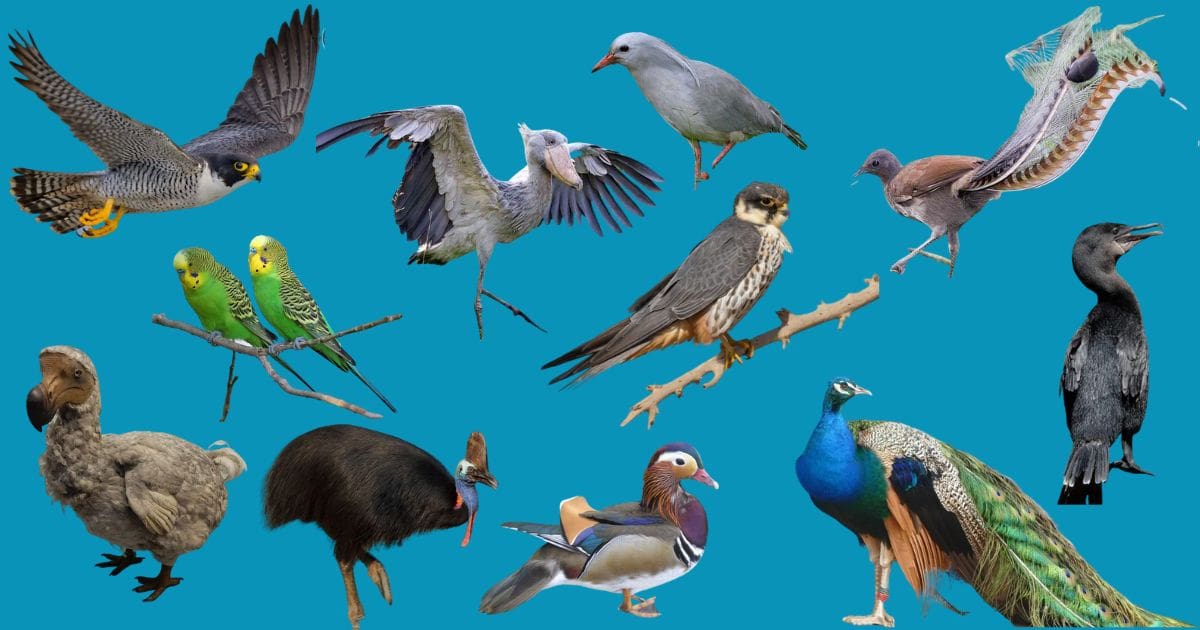
Birds are the most species-rich class of land vertebrates — approximately 10,000 known species occupying every continent including Antarctica, every habitat from deep ocean to high alpine tundra, and every ecological role from apex predator to seed disperser to decomposer.
They are the only living descendants of theropod dinosaurs, and the features most associated with them — feathers, hollow bones, a four-chambered heart, and high metabolic rate — were not invented by birds but inherited and refined from earlier lineages.
This guide covers what defines birds biologically, the major structural features that separate different bird groups, the behaviors birds are best known for, and the species that push each capability to its limit.
Table of Contents
1. Feathers: The Defining Feature and Its Many Functions
Feathers are the single trait that defines birds — every bird species has them, and no other living animal does. They evolved from filamentous structures (proto-feathers) present in several theropod dinosaur lineages before flight existed, which means feathers did not evolve for flight. They were already present for insulation and possibly display before any bird ancestor became airborne.
Modern feathers serve multiple functions simultaneously: flight (in most species), insulation, waterproofing, camouflage, display, and sensory function. The structure varies by function — contour feathers (the outer visible layer) provide aerodynamic shape; down feathers (the inner layer) trap air for insulation; semiplume feathers provide a transition between the two; filoplume feathers near the base of contour feathers detect feather position and movement through mechanoreceptors, giving birds real-time feedback on feather arrangement during flight.
Waterproofing in aquatic birds comes from preen oil — a waxy secretion from the uropygial gland at the base of the tail — that birds spread through their feathers during preening. The oil does not make feathers hydrophobic by itself; it maintains the interlocked microstructure of barbules that prevents water penetration.
Penguins, which spend months in near-freezing water, preen more frequently than almost any other bird species to maintain this barrier.
Feathers as display structures reach their most elaborate development in species where sexual selection has driven extreme ornamentation. The peacock’s tail is the most recognized example — but the male superb lyrebird of Australia can replicate the calls of over 20 other bird species, chainsaws, camera shutters, and car alarms with its syrinx (the avian vocal organ), using both visual and acoustic display simultaneously during courtship.
Our article on animals with feathers covers feather structure, function, and the range of species — beyond birds — that carry feather-like structures.
2. Flight: The Mechanics Behind the Ability Most Associated with Birds
Powered flight requires four things working simultaneously: lift generation, thrust production, weight reduction, and control. Birds achieve all four through an integrated set of structural adaptations that took over 150 million years to refine from the basic theropod body plan.
Hollow bones reduce weight without sacrificing structural integrity — the internal struts (trabeculae) inside hollow bird bones follow stress lines in a pattern that maximizes strength at minimum mass.
A frigate bird with a 2.1-meter wingspan has a skeleton weighing less than its feathers. The keel — a greatly enlarged sternum — anchors the flight muscles that can account for 25–35% of total body weight in strong fliers.
Wing shape determines flight style precisely. High-aspect ratio wings (long and narrow) — albatrosses, frigates, swifts — are built for sustained soaring and gliding with minimal energy expenditure. Elliptical wings (short and broad) — sparrows, warblers, woodland birds — allow rapid acceleration and maneuvering in confined spaces.
High-speed wings (swept back, pointed) — falcons, swifts, swallows — minimize drag at high velocity. Slotted wings (with separated primary feathers at the tips) — eagles, vultures, storks — generate lift at slow speeds and reduce induced drag during thermal soaring.
The peregrine falcon reaches speeds exceeding 390 km/h in a hunting stoop — the fastest reliably measured speed of any animal. At this velocity, the impact force of the falcon’s strike kills prey on contact. The falcon has nasal baffles — small bony projections inside the nostrils — that deflect incoming air away from the lungs during the stoop, preventing lung damage from the pressure of high-speed airflow.
3. Flightless Birds: When Wings Became Unnecessary
Flight is metabolically expensive — the energy cost of sustained powered flight is among the highest sustained energy expenditures of any animal activity. When flight is not necessary for survival — because predators are absent, food is abundant on the ground, or body size has grown too large — natural selection stops maintaining the flight apparatus and it degrades over generations.
The ratites — ostriches, emus, rheas, cassowaries, kiwis, and the extinct moa and elephant bird — represent the most species-rich group of flightless birds. They share a flat sternum (no keel, therefore no anchor point for large flight muscles) and reduced or absent wing bones.
The ostrich compensates for flight loss with speed — it reaches 69 km/h sustained and 97 km/h in short bursts — and with size, standing 2.7 meters tall and weighing up to 156 kg, making it the largest living bird and too large for most predators to threaten.
The cassowary — a large flightless bird of New Guinea and northern Australia — is considered the most dangerous bird to humans currently living. It carries a casque (bony helmet) on its head, stands 1.8 meters tall, and has a dagger-like inner toe claw reaching 12 centimeters that it uses in kicks capable of disemboweling a human.
Despite its reputation, cassowary attacks on humans are rare and almost always triggered by humans approaching too closely or attempting to feed them.
Penguins lost flight through a different path than ratites — their wings were not lost but modified into rigid, dense flippers used for underwater propulsion. Penguin “wings” are structurally unlike any other bird’s wings, with fused wrist bones that prevent folding.
They cannot be used for flight at all — but they produce swimming speeds of up to 36 km/h in chinstrap penguins, making penguins faster in water than most fish.
4. Dangerous Birds: Which Species Are Actually Threatening
Most birds pose no meaningful threat to humans. A small number carry weapons — beak size and hook curvature in raptors, talons in eagles and owls, kicks in large ratites — capable of causing serious injury. Fewer still have a documented history of attacks on humans.
The southern cassowary is ranked most dangerous by most wildlife authorities. The harpy eagle — with rear talons the size of grizzly bear claws and a grip strength measured at 1,000 psi — is capable of killing a medium-sized dog, though documented attacks on humans are extremely rare.
The great horned owl has attacked humans in defense of nesting territories, with talon punctures requiring medical treatment reported in multiple documented incidents.
Peacocks — large, visually dramatic birds kept in parks, zoos, and private gardens worldwide — are less dangerous than their size suggests in most contexts. However, wild peacocks defending territory during breeding season are capable of aggressive charges and strikes with their spurred legs.
Our article on whether peacocks are dangerous examines peacock behavior in detail — when aggression occurs, what triggers it, and how serious the risk actually is compared to the bird’s intimidating appearance.
5. Bird Intelligence: Problem-Solving Beyond Instinct
The phrase “bird brain” reflects a historical misunderstanding of avian neurology. Birds have no neocortex — the brain structure associated with complex cognition in mammals — but they have a functionally equivalent structure called the pallium that performs the same roles. Modern neuroscience has largely abandoned the assumption that neocortex-based cognition is the only pathway to complex thought.
New Caledonian crows manufacture tools — selecting specific leaf edges, trimming them to a consistent width and hook shape, and using them to extract grubs from wood — in a process that involves planning for future use. They have been observed saving tools between uses and selecting tools based on the specific task ahead, not just the immediate problem.
They also pass tool designs between individuals through social learning, producing regional tool-use traditions equivalent to what anthropologists call culture in human groups.
African grey parrots demonstrate numerical ability, understanding of absence (zero), and the capacity to use English words not just as conditioned responses but to communicate original requests — asking for objects by combining words they have not been explicitly taught to pair. Alex, the most studied African grey, demonstrated an understanding of categories, colors, materials, and relative size that requires abstract reasoning rather than pattern matching.
Eurasian jays conceal food from potential thieves by moving cached items when they know they have been watched during caching — and they do this selectively, moving items watched by specific individuals from those individuals’ view without moving items from locations not seen by the watcher. This behavior requires a model of what another individual knows — a cognitive capacity called theory of mind that was previously considered exclusive to great apes.
6. Migration: Birds as the Most Accomplished Navigators in Nature
Bird migration covers distances and requires navigational precision that remain incompletely understood despite decades of research. Birds use a documented combination of at least five navigational systems simultaneously: magnetic field detection (using cryptochrome proteins in the eye that are sensitive to Earth’s magnetic field), star pattern recognition, sun compass (using the sun’s position corrected for time of day), olfactory mapping in some species, and memorized landmark recognition.
The bar-tailed godwit holds the non-stop flight distance record — flying 12,200 kilometers from Alaska to New Zealand in approximately 11 days without landing, eating, drinking, or sleeping in the conventional sense. Before departure, the godwit’s digestive organs shrink by 25% to reduce weight and free up metabolic capacity for sustained muscle use. It doubles its body weight in fat reserves in the weeks before departure and burns through all of it during the crossing.
Migration is covered in depth — including the species records, navigation mechanisms, and the ecological triggers that initiate migration — in our article on animals that migrate, which covers bird migration alongside migration in mammals, fish, and insects.
7. Bird Beaks: Anatomy Shaped Entirely by Diet
A bird’s beak is one of the most precise indicators of its diet and feeding method of any anatomical feature in the animal kingdom. Beak shape, length, curvature, and tip structure are under strong selective pressure from feeding efficiency — small differences in beak geometry produce large differences in how effectively a bird can access its food source.
Darwin’s finches on the Galapagos Islands are the textbook example: 15 species descended from a single ancestor, each with a beak shape matched to a specific food source — seeds of different hardness, cactus flowers, insect larvae in wood, blood of other birds. The seed-cracking species have deep, thick beaks generating high bite force; the insect-probing species have long, narrow beaks for extracting prey from crevices; the cactus-feeding species have curved beaks matching cactus flower geometry.
The longest beak relative to body size belongs to the sword-billed hummingbird — its beak exceeds its body length, an adaptation specifically for feeding from passionflower species with corolla tubes too deep for any other pollinator to reach.
The relationship is so exclusive that the sword-billed hummingbird is the primary or sole pollinator of several passionflower species, and the flowers’ tube length has co-evolved with the beak length over millions of years. Future articles in this category will cover long-beaked birds in dedicated detail.
8. Swimming Birds: When Wings Went Underwater
Several bird lineages independently evolved swimming as a primary locomotion mode — penguins, diving ducks, cormorants, loons, grebes, and gannets among them.
Each solved the challenge of underwater movement differently, and the degree of aquatic specialization varies from birds that simply swim on the surface to birds that dive hundreds of meters and spend most of their life at sea.
Cormorants lack the fully waterproof plumage of most waterbirds — their feathers wet through during diving, which reduces buoyancy and makes diving easier but requires the bird to dry its wings after each dive. The iconic wing-spreading posture of cormorants standing with wings outstretched is functional drying behavior, not display.
Gannets dive from heights of 30 meters, reaching speeds of 100 km/h on entry, using a heavily reinforced skull and air sac system beneath the skin of the breast and neck to absorb the impact force of high-speed water entry. Future articles will cover swimming and diving birds in dedicated detail.
What Birds Show Us About Vertebrate Adaptation
Birds demonstrate more clearly than almost any other vertebrate group how a single body plan — the theropod dinosaur skeleton — can be modified by natural selection into an extraordinary range of functional designs.
The same basic skeletal elements appear in a hummingbird weighing 2 grams and an ostrich weighing 156 kilograms, in a swift that spends most of its life airborne and a penguin that cannot leave the water for long.
The articles in this category go deeper into each bird group and capability — follow the links throughout this guide for species-specific detail, or check back as future articles cover flightless birds, long-beaked species, colorful birds, and the fastest fliers in dedicated depth.

I have loved animals since I was a kid. I enjoy reading about how animals live, eat, move, and survive. I started Animals Window to share what I learn in a simple and easy way. I write about animal body parts, size, behavior, diet, habitats, and species. My goal is to make animal facts clear and fun for everyone to understand.