Blue is the rarest natural color in the animal kingdom. True blue pigment almost never exists in nature — most blue animals create color through light-bending structures in their skin, feathers, or shells. From a tiny sea slug that floats upside down to a parrot so blue it was declared extinct, these 20 blue animals are some of the most visually jaw-dropping creatures on Earth.
Table of Contents
Quick Blue Animals Table
| Animal Name | Scientific Name | Key Trait |
| Blue Glaucus | Glaucus atlanticus | Floats upside down on surface tension |
| Blue Lobster | Homarus americanus | 1-in-2-million genetic mutation |
| Spix’s Macaw | Cyanopsitta spixii | Critically endangered; inspired Rio |
| Hyacinth Macaw | Anodorhynchus hyacinthinus | Largest flying parrot on Earth |
| Blue-ringed Octopus | Hapalochlaena lunulata | Venom kills a human in minutes |
| Mandarin Dragonet | Synchiropus splendidus | Only vertebrate with true blue pigment |
| Carpathian Blue Slug | Bielzia coerulans | Bright blue warns predators away |
| Blue Iguana | Cyclura lewisi | Critically endangered; fewer than 1,000 left |
| Sinai Agama | Pseudotrapelus sinaitus | Males turn electric blue during mating |
| Cobalt Blue Tarantula | Cyriopagopus lividusm | Fastest strike of any pet tarantula |
| Blue Parrotfish | Scarus coeruleus | Eats coral; poops white sand |
| Greater Blue-ringed Octopus | Hapalochlaena lunulata | Rings flash warning in 0.3 seconds |
| Ribbon Eel | Rhinomuraena quaesita | All born male; turn female to reproduce |
| Purple Honeycreeper | Cyanerpes caeruleus | Curved bill fits one flower species only |
| Blue Dasher | Pachydiplax longipennis | Male guards mate zone mid-hover |
| Ulysses Butterfly | Papilio ulysses | Wings create color through nanoscale prisms |
| Steel Blue Ladybird | Halmus chalybeus | Introduced to fight scale insects |
| Russian Blue Cat | Felis catus | Coat absorbs light at unique frequency |
| Humphead Wrasse | Cheilinus undulatus | Can live 30 years; changes sex if needed |
| Blue Coral Snake | Calliophis bivirgata | Venom attacks nerves, not blood |
More Post: 49 Animals That Migrate in the World (With Pictures & Unique Facts)
Hook: The Truth About Blue in Nature
Here’s the surprising part — if you ground up a blue butterfly wing and looked at the powder under a microscope, it would appear brown or black. Almost no animal on Earth actually has blue pigment. Instead, they grow microscopic nanostructures that scatter light the same way the sky does. The result looks blue to our eyes, but the animal is, at the cellular level, not blue at all.
That’s just one strange twist. Wait until you read about the sea slug that stores stinging cells from jellyfish it eats and uses them as its own weapons. Or the eel that spends its entire life as one sex before switching. Or the octopus smaller than your palm that can kill 26 adult humans with a single bite.
Stick around. Every animal on this list does something the others don’t.
1. Blue Glaucus
- Scientific Name: Glaucus atlanticus
- Size: Up to 3 cm (about the length of a paper clip)
- Weight: Less than 1 gram
- Diet: Portuguese man o’ war, other floating hydrozoans
- Habitat: Open ocean surface worldwide
- Lifespan: 1 year
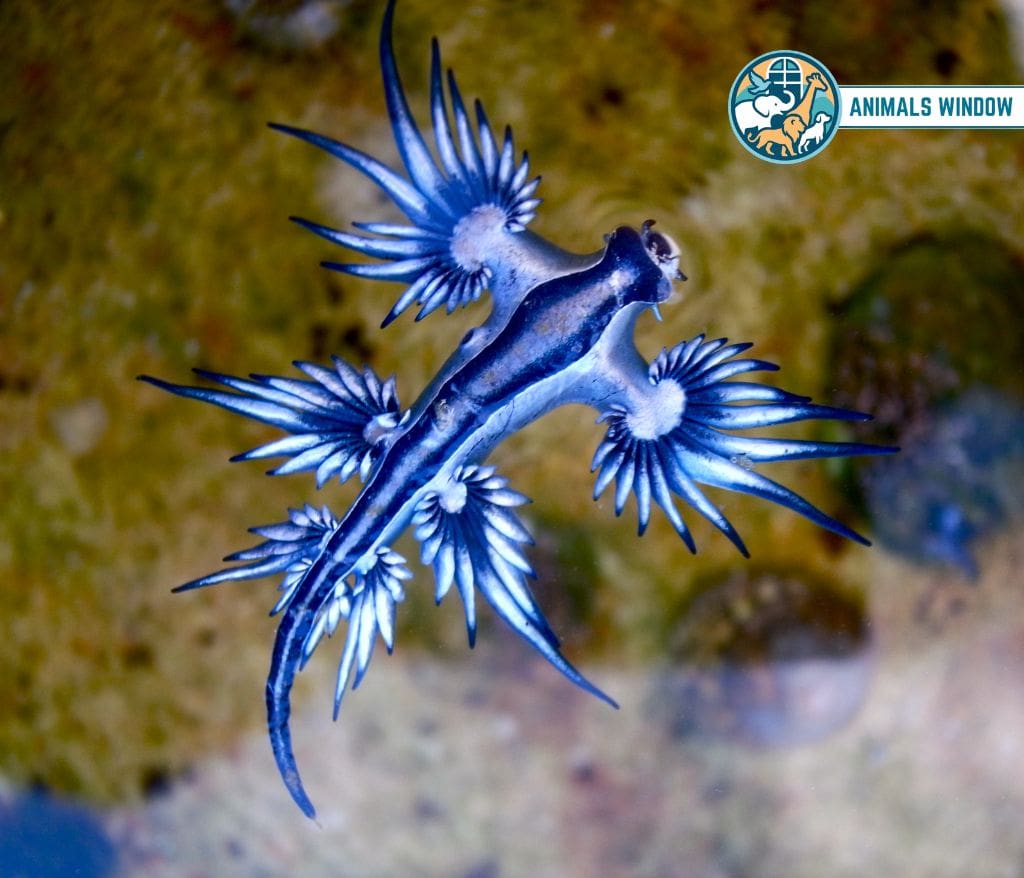
The Blue Glaucus is basically a floating ambush predator the size of a thumbnail. It lives on the surface of warm oceans, hanging upside down from the water’s surface film. Its silver side faces up toward the sky; its blue side faces down toward the deep. This makes it nearly invisible to predators from both directions at once.
What makes it genuinely strange is its diet. It hunts Portuguese man o’ war — one of the ocean’s most venomous animals. Instead of dying from the man o’ war’s stinging cells, it eats them and stores those cells in special sacs at its body tips. The sting it delivers is actually stronger than the man o’ war’s original sting.
🔥 Comparison Fact: About the size of a paper clip — but holds enough stolen venom to cause serious pain in a grown adult.
2. Blue Lobster
- Scientific Name: Homarus americanus
- Size: Up to 60 cm (about the length of a school ruler, doubled)
- Weight: 0.5–4 kg
- Diet: Fish, clams, crabs, mussels
- Habitat: North Atlantic Ocean, rocky coastal floors
- Lifespan: Up to 100 years
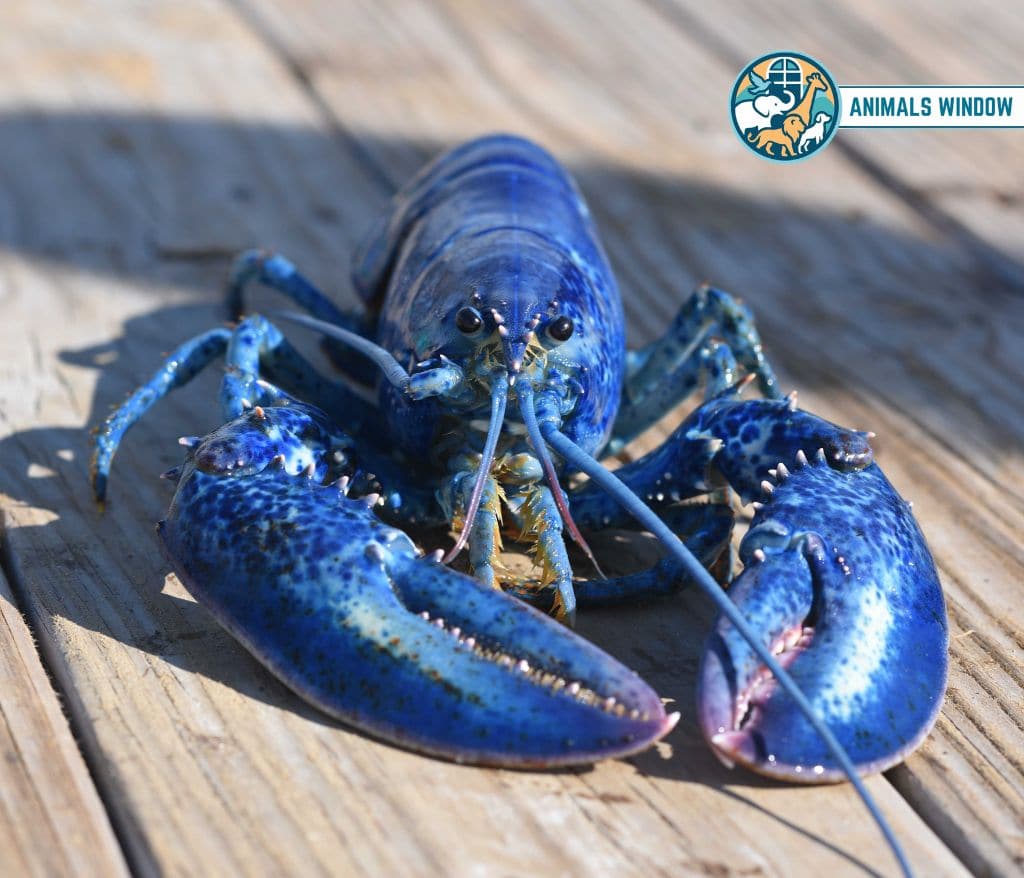
Most lobsters are dark greenish-brown. A blue lobster is a genetic accident — a random mutation causes overproduction of a protein called crustacyanin, which binds to the shell pigment astaxanthin and turns it bright blue. The odds of catching one sit at roughly 1 in 2 million.
Despite the color, blue lobsters behave identically to regular ones. They hunt, molt, and mate the same way. What changes is visibility. In the wild, standing out bright blue on a rocky ocean floor is a serious disadvantage, which is likely why this mutation stays rare. Many blue lobsters caught by fishermen end up in aquariums instead of on plates.
🔥 Comparison Fact: A full-grown blue lobster weighs about as much as a standard bag of flour.
3. Spix’s Macaw
- Scientific Name: Cyanopsitta spixii
- Size: 56 cm beak to tail
- Weight: Around 300 g
- Diet: Cacti seeds, euphorb seeds, native fruits
- Habitat: Gallery forests in northeast Brazil (now functionally extinct in wild)
- Lifespan: Up to 28 years in captivity
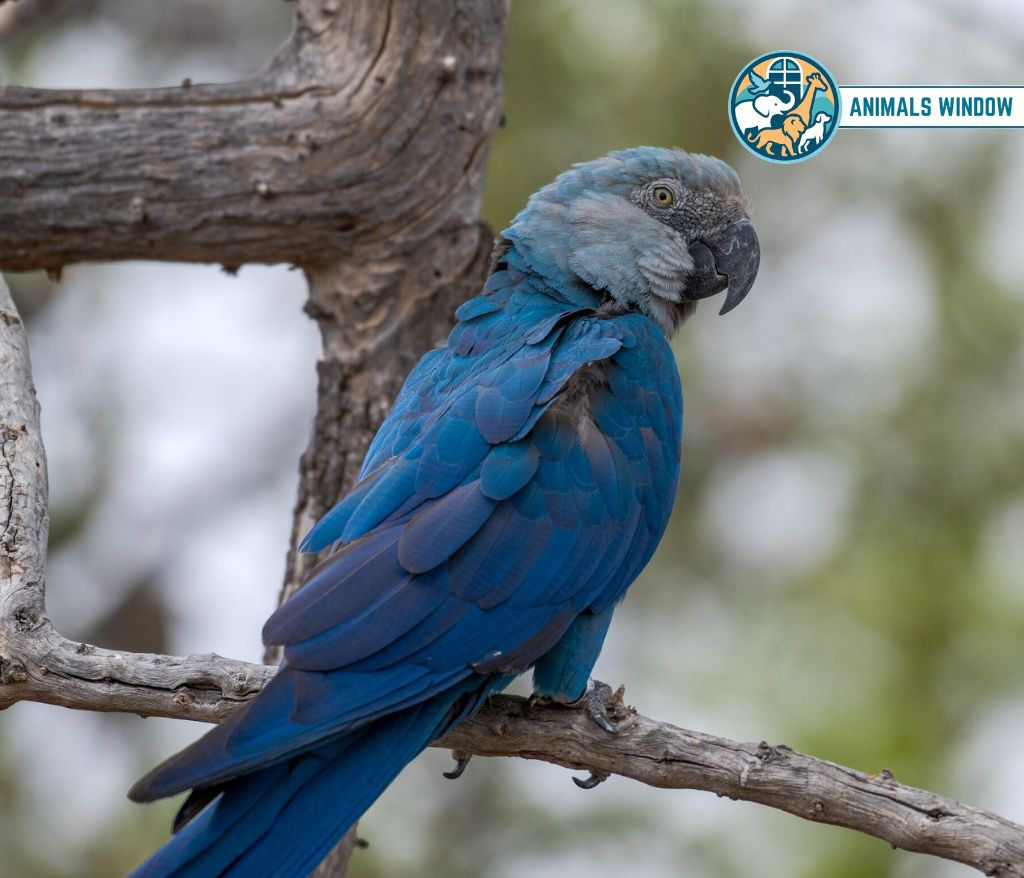
Spix’s Macaw inspired the movie Rio — and the film’s sad backstory is basically true. The last wild Spix’s Macaw disappeared around 2000. The bird’s entire wild population had been wiped out by deforestation and illegal trapping. Today, around 160–180 individuals exist only in captivity, carefully managed by conservation programs.
The bird’s color is a cool, pale sky blue — different from the rich violet-blues of other macaws. What’s striking is how perfectly it matched the silvery-blue leaves of the caraatinga trees it depended on, which also no longer exist in significant numbers. Losing the bird and losing the tree happened almost simultaneously.
🔥 Comparison Fact: Weighs about as much as a deck of playing cards — but its species’ survival cost millions in conservation funding.
4. Hyacinth Macaw
- Scientific Name: Anodorhynchus hyacinthinus
- Size: Up to 100 cm long
- Weight: 1.2–1.7 kg
- Diet: Palm nuts (especially from Acrocomia and Attalea palms)
- Habitat: Pantanal wetlands, Cerrado, Brazil, Bolivia, Paraguay
- Lifespan: 60+ years in captivity
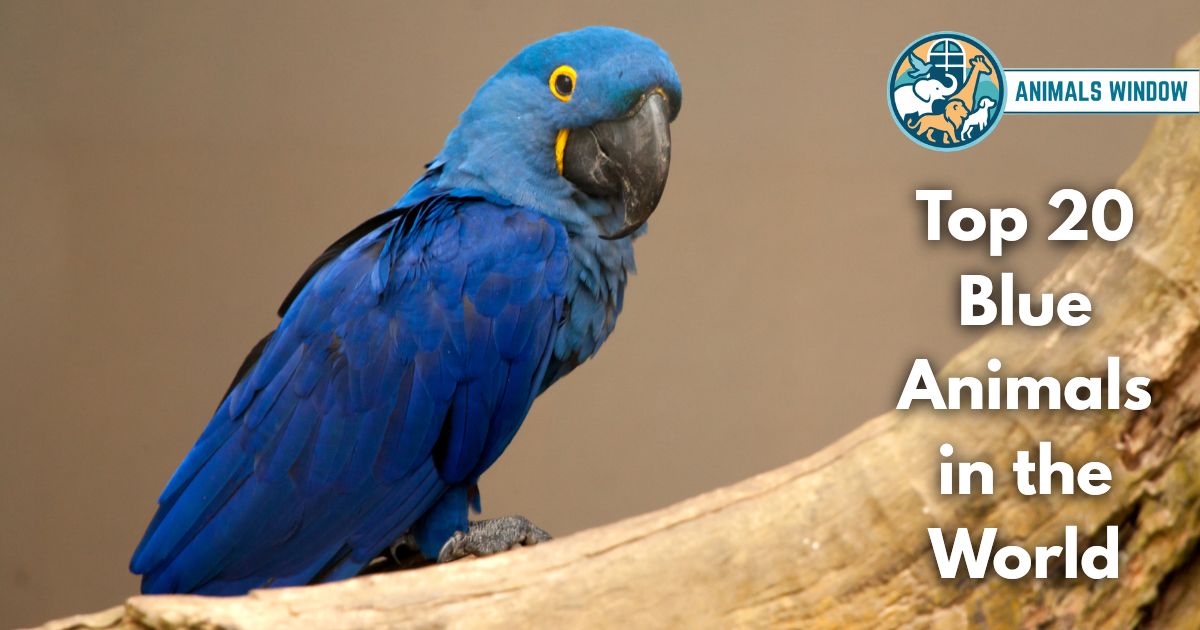
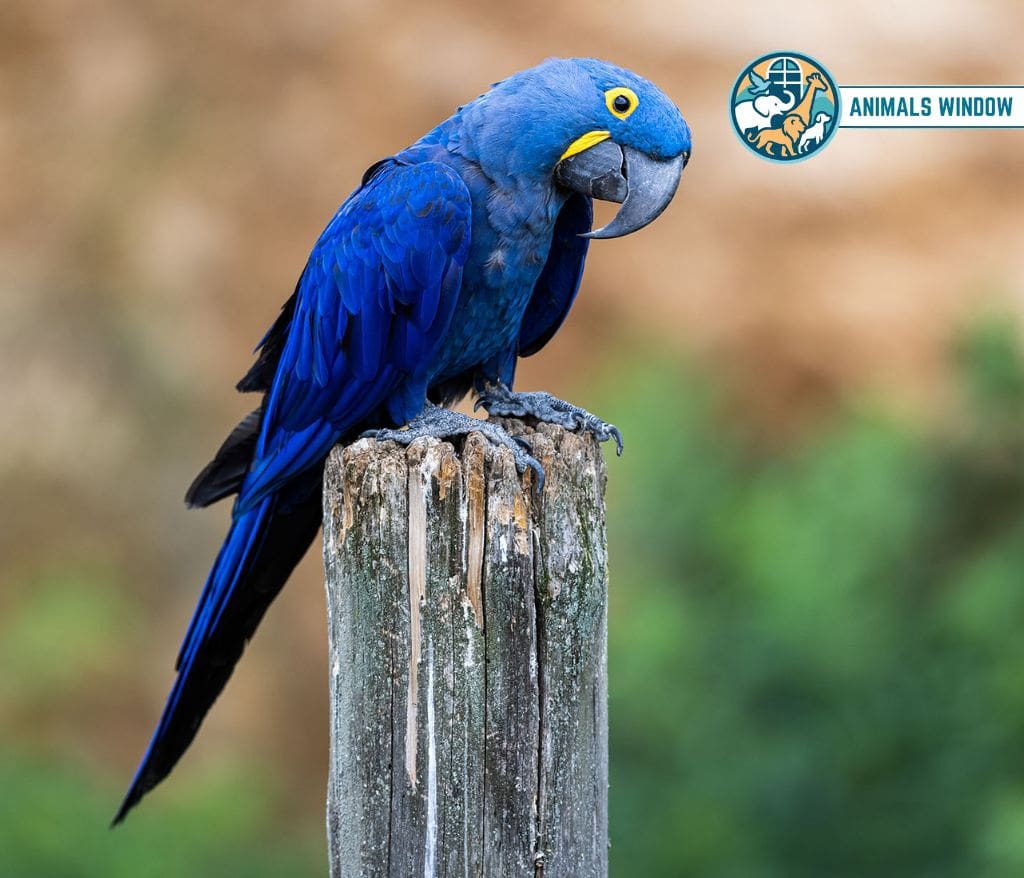
The Hyacinth Macaw is the largest flying parrot in the world — a rich cobalt blue from beak to tail tip, with bright yellow rings around its eyes and at the base of its jaw. A single wing can span over 60 cm. Watching one fly is like watching a bright blue kite drift through a canopy.
Its beak is so powerful it can crack open coconut shells. But here’s the catch: the palm nuts it prefers are so hard that even cows can’t digest the ones they eat. The macaw doesn’t crack these nuts alone — it waits for them to pass through cattle or be softened by weathering first, then finishes the job.
🔥 Comparison Fact: A Hyacinth Macaw stretches about as long as a standard guitar from headstock to base.
5. Blue-ringed Octopus
- Scientific Name: Hapalochlaena lunulata
- Size: 12–20 cm including arms
- Weight: 10–100 g
- Diet: Small crabs, shrimp, small fish
- Habitat: Tidal pools, coral reefs — Indo-Pacific
- Lifespan: 1–2 years
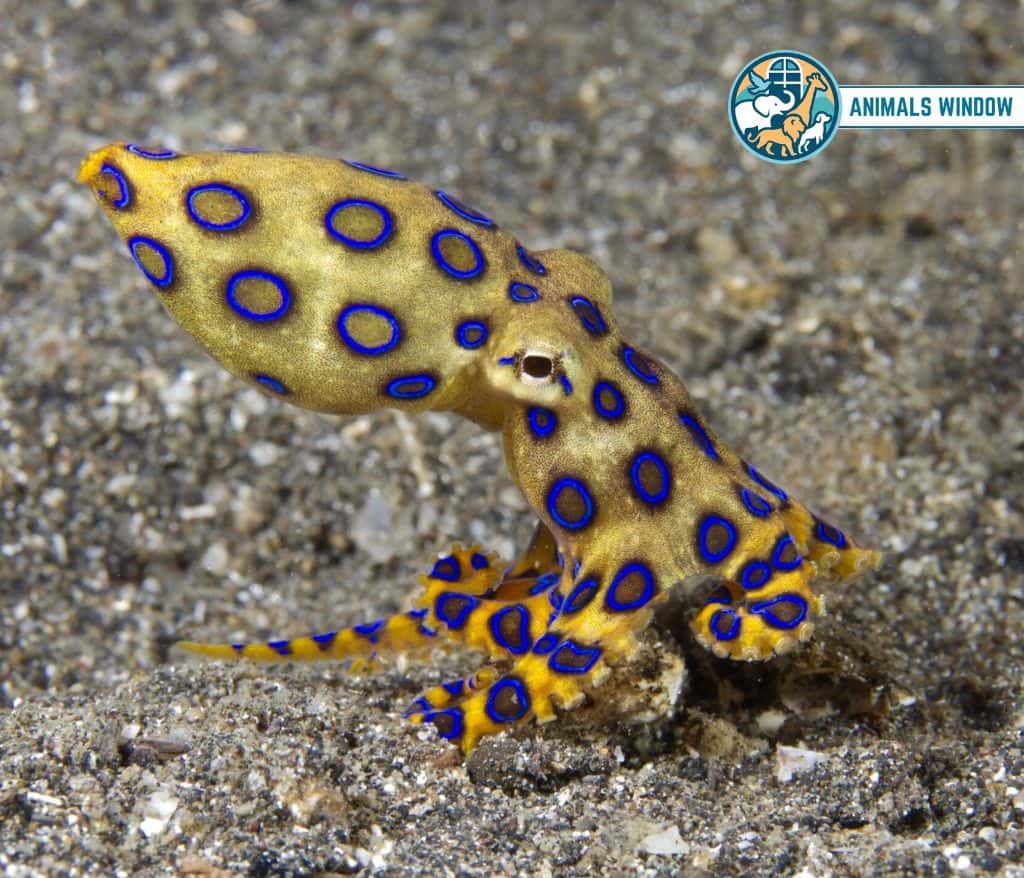
This is one of the most venomous animals alive, hidden in one of the most disarmingly pretty packages. At rest, the blue-ringed octopus looks dull brown. The moment it feels threatened, 60+ iridescent blue rings flash across its body — a warning.
Its venom is tetrodotoxin (TTX), the same neurotoxin found in puffer fish. It’s produced not by the octopus itself but by bacteria living inside it. A single individual carries enough to kill 26 adult humans. There is no antivenom. The only treatment is hours of artificial breathing until the toxin clears.
🔥 Comparison Fact: This animal weighs less than a golf ball but produces enough venom to kill a classroom full of adults.
6. Mandarin Dragonet
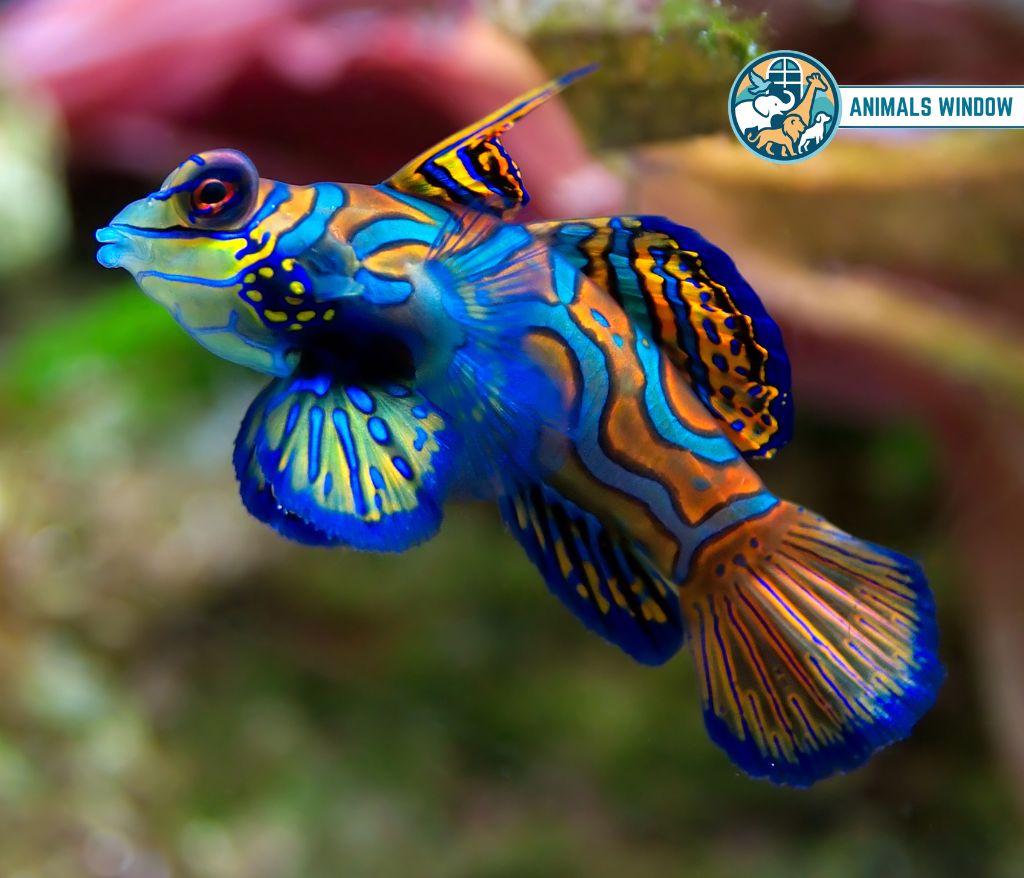
- Scientific Name: Synchiropus splendidus
- Size: Up to 6 cm
- Weight: A few grams
- Diet: Tiny crustaceans, worms, protozoa
- Habitat: Shallow coral lagoons — Pacific Ocean
- Lifespan: 10–15 years
The Mandarin Dragonet is one of the most visually complex fish on the reef — turquoise, orange, green, and blue swirling across its tiny body like a hand-painted ceramic. But what makes it scientifically unusual is how that blue exists. It’s the only known vertebrate that produces true blue pigment (cyanophore cells) rather than using light-bending structures. Every other blue vertebrate you’ll meet on this list is a structural illusion. This one is actually, chemically blue.
It also lacks scales. Instead, it’s covered in a thick, foul-smelling mucus that most predators find deeply unpleasant. Its beautiful colors are probably a warning: don’t eat me, I taste terrible.
🔥 Comparison Fact: Small enough to sit on a bottle cap, yet it has the most complex color chemistry of any vertebrate its size.
7. Carpathian Blue Slug
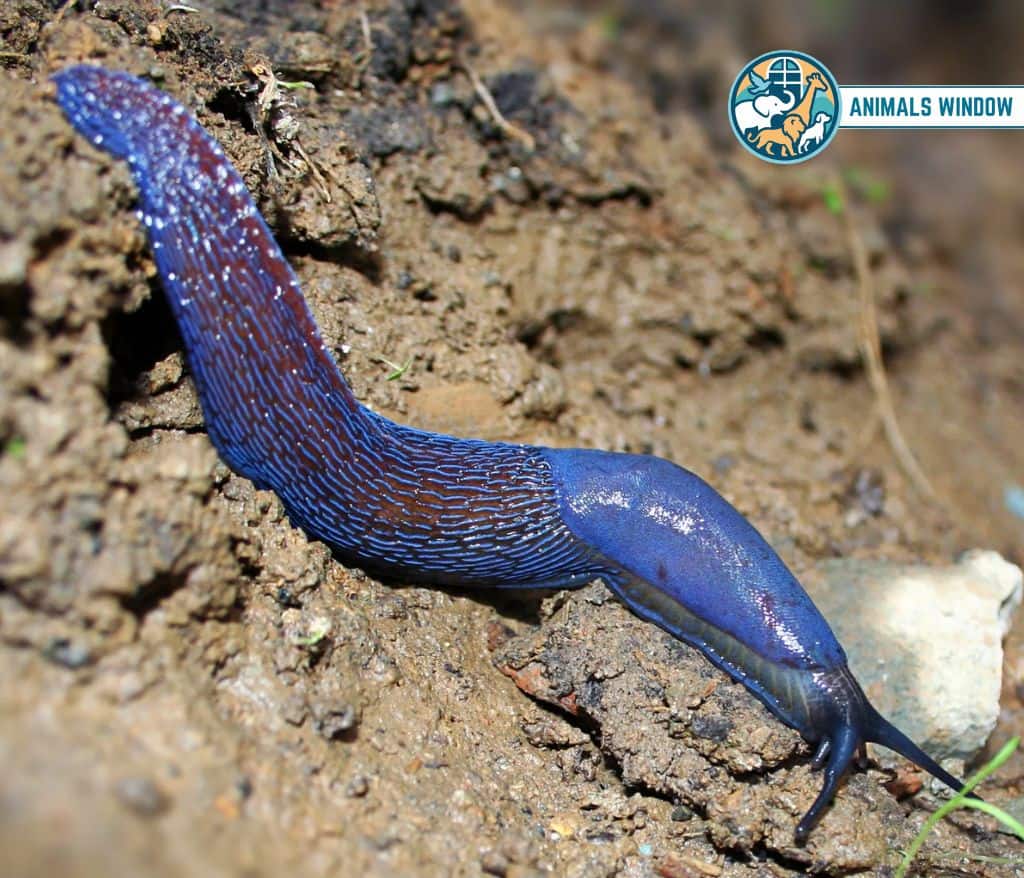
- Scientific Name: Bielzia coerulans
- Size: Up to 14 cm when extended
- Weight: A few grams
- Diet: Decaying plant matter, fungi, algae
- Habitat: Mountain forests of the Carpathian region, central Europe
- Lifespan: 1–3 years
Most slugs are beige, gray, or brown — colors that say “please ignore me.” The Carpathian Blue Slug is a vivid steel-blue, and that color is intentional. It’s an aposematic signal — bright coloring that warns predators the animal may taste bad or be dangerous.
Young Carpathian Blue Slugs are actually brown. The blue develops as they mature, becoming deeper and more intense with age. When threatened, they can contract their body into a tight ball and rock side to side — a behavior called isopodan defense rocking — making it harder for a bird to grab them cleanly.
🔥 Comparison Fact: When fully stretched, this slug is about as long as a standard pen.
8. Blue Iguana
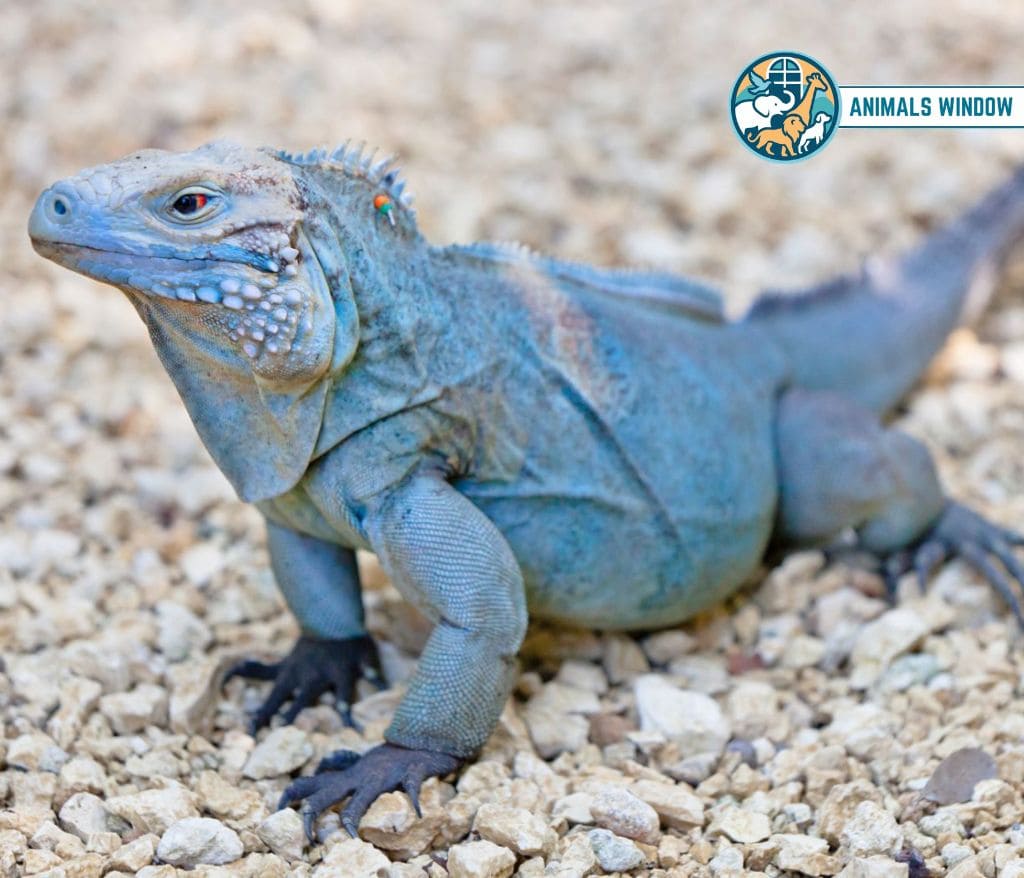
- Scientific Name: Cyclura lewisi
- Size: Up to 150 cm
- Weight: Up to 14 kg
- Diet: Fruit, flowers, leaves, some insects
- Habitat: Grand Cayman Island — rocky, dry forests and scrubland
- Lifespan: Up to 69 years
The Blue Iguana is one of the longest-lived lizards on Earth. And it’s one of the most endangered. Fewer than 1,000 individuals exist today, all on a single island: Grand Cayman. Habitat destruction, feral cats, and being hit by cars brought the population down to roughly 15 individuals at its lowest in the early 2000s.
The blue color isn’t constant. It intensifies when the iguana basks in sunlight or wants to communicate dominance. In shade or when stressed, it fades to gray. The color change happens through chromatophores — pigment cells that expand and contract. Think of it as mood lighting controlled by body temperature and social context.
🔥 Comparison Fact: This iguana can weigh as much as a medium-sized dog and live longer than most people keep their cars.
9. Sinai Agama
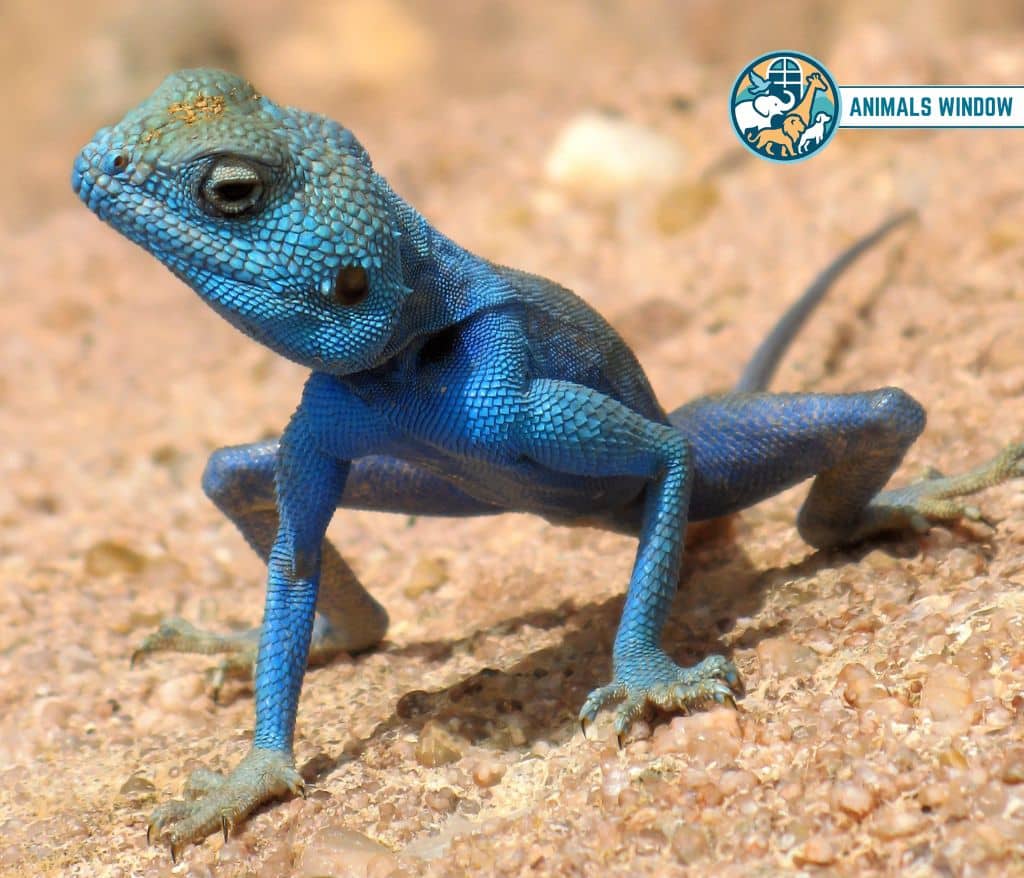
- Scientific Name: Pseudotrapelus sinaitus
- Size: 20–30 cm
- Weight: 30–90 g
- Diet: Insects, small invertebrates
- Habitat: Rocky deserts of the Sinai Peninsula, Middle East, and North Africa
- Lifespan: 5–10 years
Female Sinai Agamas look like small, unremarkable desert lizards. Males look like something that fell out of a jewelry box. During mating season, the male’s entire body turns an electric sky-blue that can be spotted from dozens of meters away against pale desert rock.
The color switch is driven by testosterone. Outside of breeding season, males revert to the same brown-gray as females. The shift can happen within hours of conditions changing. What’s stranger still: the brighter and more saturated a male’s blue is, the higher his parasite load tends to be lower — females actually use color saturation as a health indicator when choosing mates.
🔥 Comparison Fact: A male Sinai Agama weighs about as much as a large egg — but glows bright blue across a sun-bleached desert.
10. Cobalt Blue Tarantula
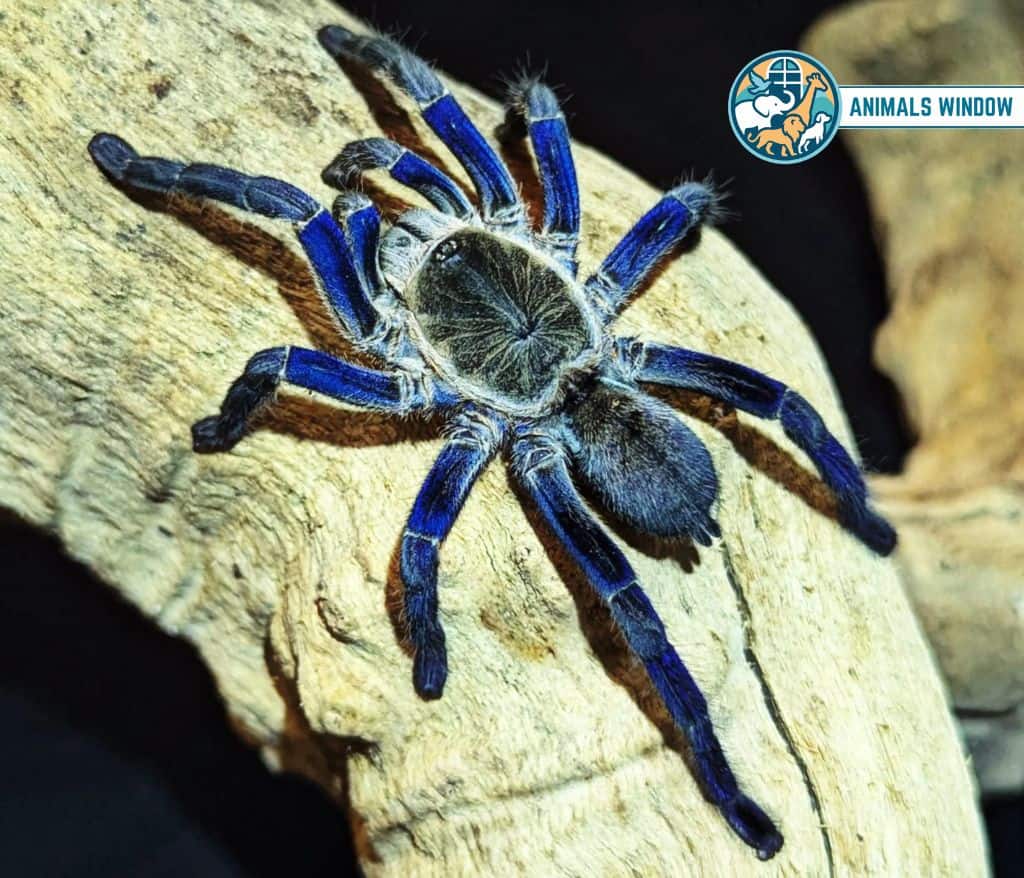
- Scientific Name: Cyriopagopus lividus
- Size: 13–18 cm leg span
- Weight: 30–90 g
- Diet: Insects, small lizards, possibly small mice
- Habitat: Tropical forests of Myanmar and Thailand; deep burrows
- Lifespan: Females up to 25 years; males 3–5 years
The Cobalt Blue Tarantula barely comes out. It lives in deep underground burrows in humid tropical forests and emerges mostly at night to ambush passing insects. Its legs are an intense metallic cobalt blue. Its abdomen is dark gray. The contrast makes it look almost artificial — like something designed in a lab.
It’s fast. Very fast. Its strike speed has been clocked at under 0.1 seconds, making it one of the fastest ambush predators relative to body size in the arachnid world. Pet keepers rank it among the most defensive tarantulas available — it doesn’t hesitate to bite, and its venom, while not medically dangerous to healthy adults, causes significant pain and swelling.
🔥 Comparison Fact: Its leg span is roughly the width of a human hand — and it moves faster than most people can flinch.
More Posts: 30 Most Energetic Animals (Ranked by Speed & Stamina With Pictures)
11. Blue Parrotfish
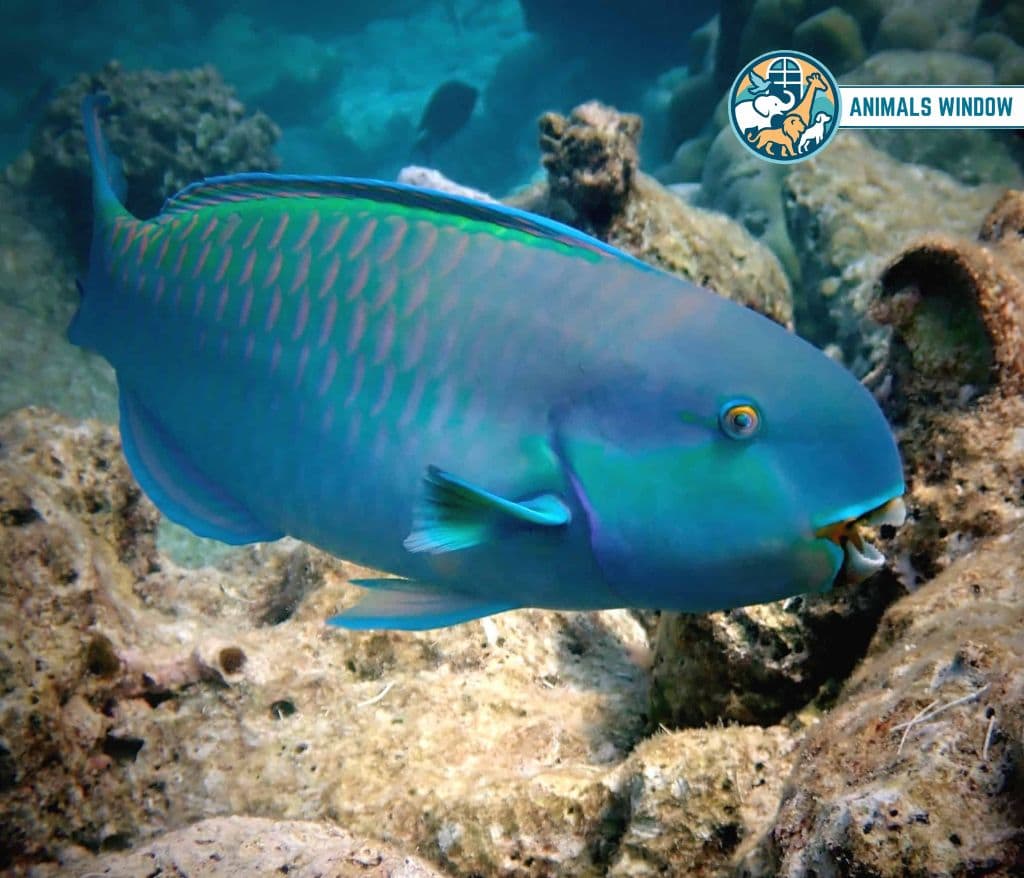
- Scientific Name: Scarus coeruleus
- Size: Up to 90 cm
- Weight: Up to 20 kg
- Diet: Algae scraped from coral and rock surfaces
- Habitat: Coral reefs — Caribbean Sea, western Atlantic
- Lifespan: Up to 7 years
The Blue Parrotfish is almost entirely powder blue, with a bright yellow patch near its mouth that fades with age. Its beak — actually fused teeth — is strong enough to bite through coral rock. It does this to reach the algae hiding inside.
Here’s where it gets wild. All that coral and rock it bites off gets digested, and what comes out the other end is fine white sand. A single large Blue Parrotfish can produce up to 90 kg of white sand per year. Much of the white sand beach you’ve walked on in the Caribbean was made by parrotfish. The beautiful beaches exist, in part, because fish have been eating coral for millions of years.
🔥 Comparison Fact: This fish produces roughly the weight of a large adult human in white sand every single year.
12. Greater Blue-ringed Octopus
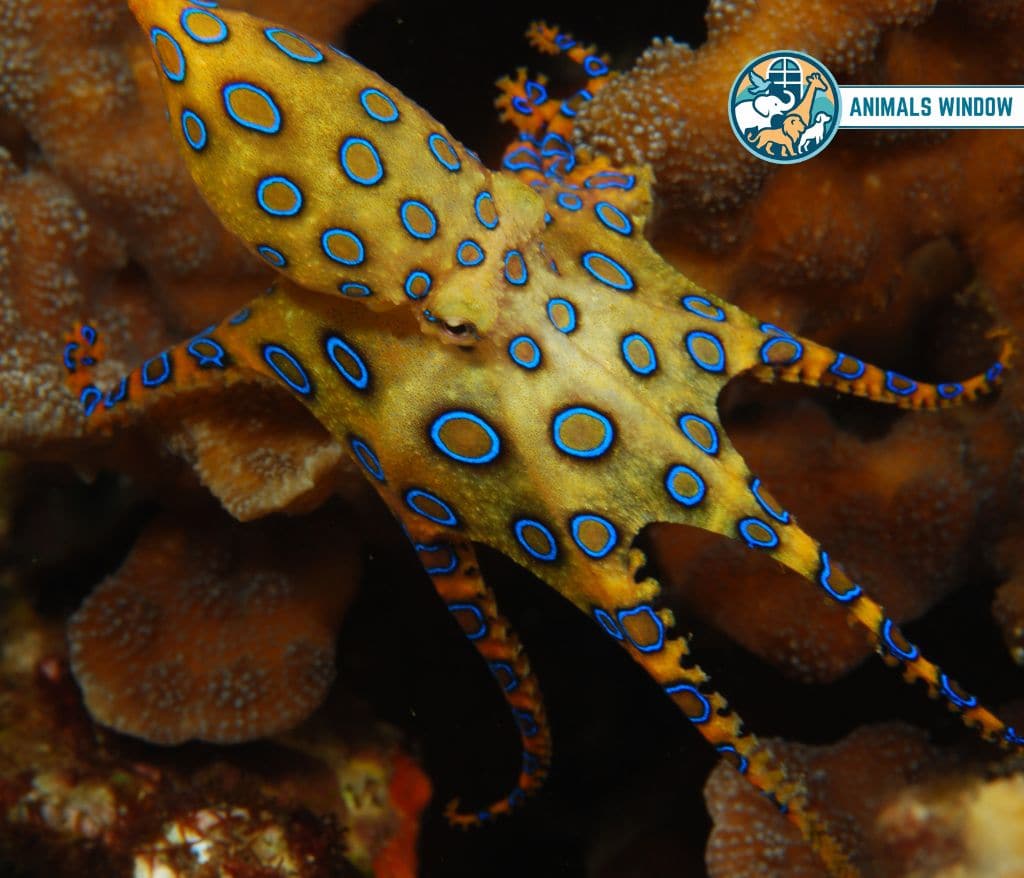
- Scientific Name: Hapalochlaena lunulata
- Size: 10–20 cm including arms
- Weight: Up to 80 g
- Diet: Crabs, shrimp, injured fish
- Habitat: Coral and rock reefs from Australia to Japan
- Lifespan: About 1–2 years
While similar to the smaller blue-ringed octopus, the Greater Blue-ringed Octopus is distinguished by the size and pattern of its rings — they’re larger, more defined, and flash in under 0.3 seconds. This speed matters: it’s fast enough to be a visual alarm that registers before most predators can complete an attack motion.
Its hunting method is precise. It approaches prey slowly, changes color to blend with the background, then injects venom through a painless bite. Victims of human envenomation often don’t realize they’ve been bitten until paralysis begins. The toxin blocks nerve signals from reaching muscles — the lungs stop working before consciousness fades.
🔥 Comparison Fact: Weighs less than a smartphone yet produces a toxin complex enough that no laboratory has synthesized a working antidote.
13. Ribbon Eel
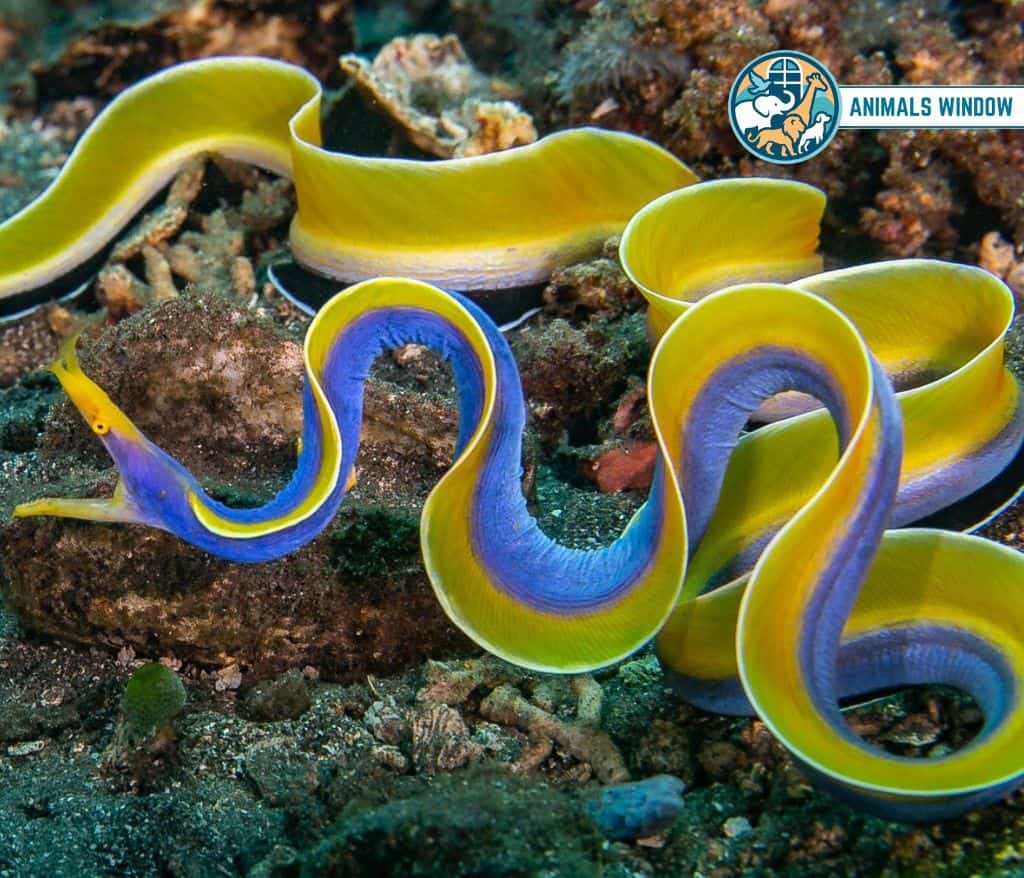
- Scientific Name: Rhinomuraena quaesita
- Size: Up to 130 cm
- Weight: Around 50–100 g
- Diet: Small fish, shrimp
- Habitat: Sand beds near coral reefs — Indo-Pacific
- Lifespan: Up to 20 years
The Ribbon Eel moves through the water like a piece of blue and yellow silk caught in a current. Its head features elaborate nasal flares — leaf-shaped projections that funnel water toward scent receptors and make it look almost like a tiny dragon.
Every Ribbon Eel is born male. They mature as vivid blue and yellow juveniles, live as adult males in their blue phase, and then, when conditions are right, transform into females. The female phase brings a complete color shift to solid yellow. This transition is irreversible. A yellow Ribbon Eel in the wild is always female.
🔥 Comparison Fact: At 130 cm, a full-grown Ribbon Eel is about as long as a standard guitar is tall when stood on its end — but weighs about as much as a banana.
14. Purple Honeycreeper
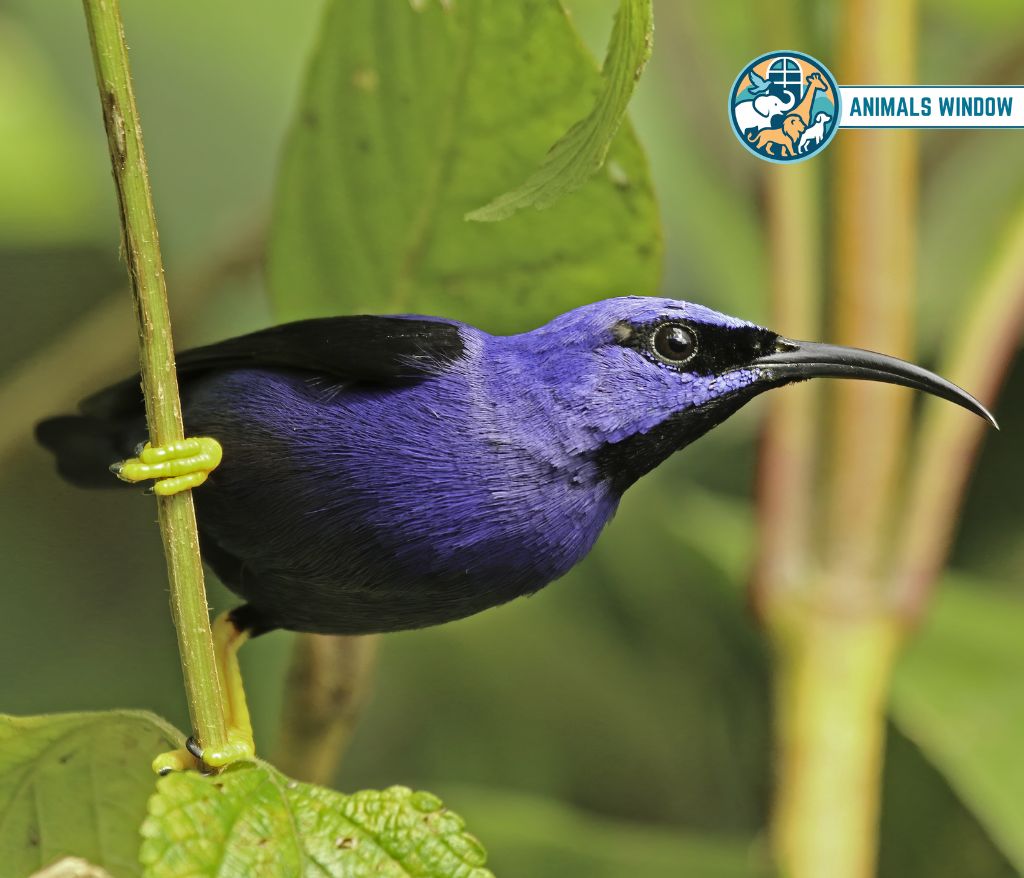
- Scientific Name: Cyanerpes caeruleus
- Size: Around 10 cm
- Weight: 12–14 g
- Diet: Nectar, berries, some insects
- Habitat: Forest canopy — Trinidad and northern South America
- Lifespan: 3–10 years
The Purple Honeycreeper sits at that blue-purple borderline where the color looks entirely different depending on lighting. In bright sun, it flashes a deep cobalt. In shade, it shifts toward rich purple-blue. The yellow legs and the contrast against the dark forest canopy make it look like it’s lit from within.
Its bill curves downward in an arc specifically matched to certain flower species. It doesn’t just prefer these flowers — its bill geometry physically prevents it from easily feeding at straight-tubed flowers. This is co-evolution in action: the bird and the flower shaped each other over thousands of generations. Remove one, and the other suffers.
🔥 Comparison Fact: This bird weighs about as much as four standard paperclips — and its bill is a biological key designed for one specific lock.
15. Blue Dasher
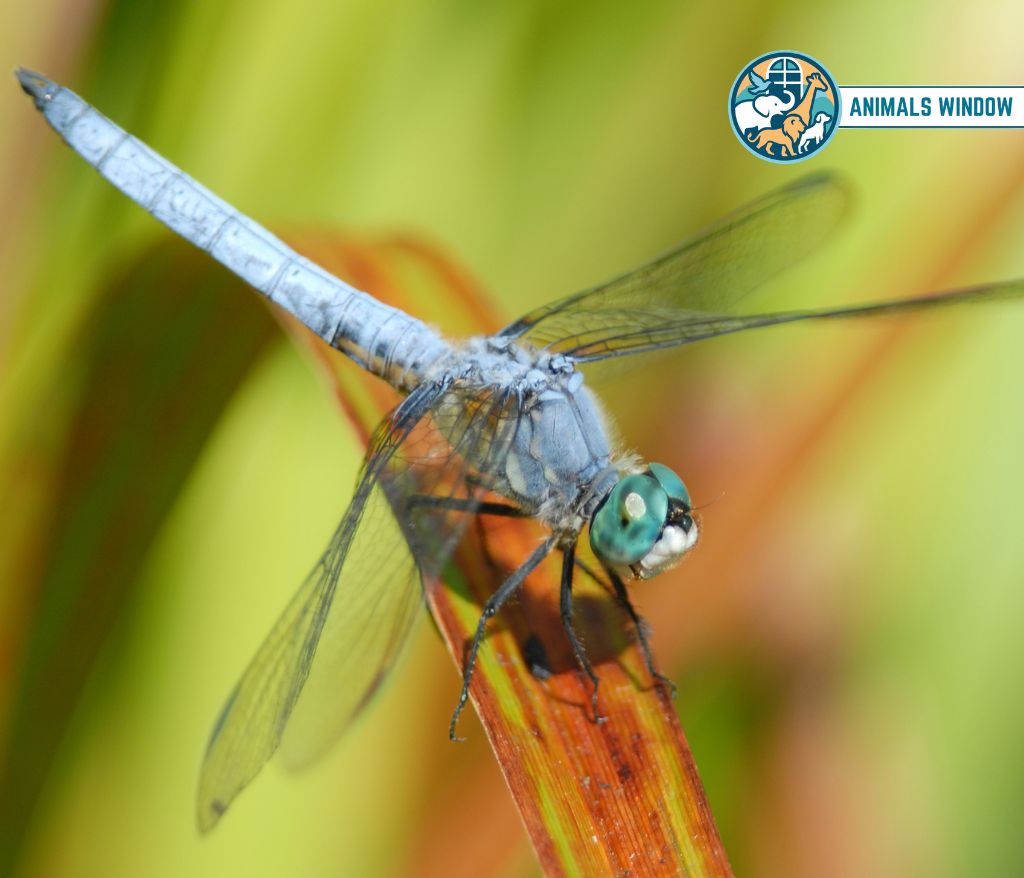
- Scientific Name: Pachydiplax longipennis
- Size: 2.5–4 cm body length; wingspan up to 5.5 cm
- Weight: Less than 1 gram
- Diet: Mosquitoes, gnats, flies, small insects
- Habitat: Ponds, slow-moving streams — North America
- Lifespan: Adults live just 2–4 weeks after emerging
The Blue Dasher is a North American dragonfly with a powder-blue abdomen and striking green eyes. What it lacks in size it makes up for in hunting precision. It catches around 95% of every insect it targets — one of the highest aerial hunting success rates of any predator on Earth, including birds and large mammals.
Male Blue Dashers claim a perch near water and defend it aggressively. But they don’t hover randomly — they perform a behavior called obelisking, pointing their tail directly at the sun during midday heat to minimize the body surface exposed to direct sunlight. It’s a built-in thermostat using nothing but body position.
🔥 Comparison Fact: The Blue Dasher’s body is roughly the length of a large paper clip — but it catches more than 9 out of every 10 prey items it chases.
16. Ulysses Butterfly
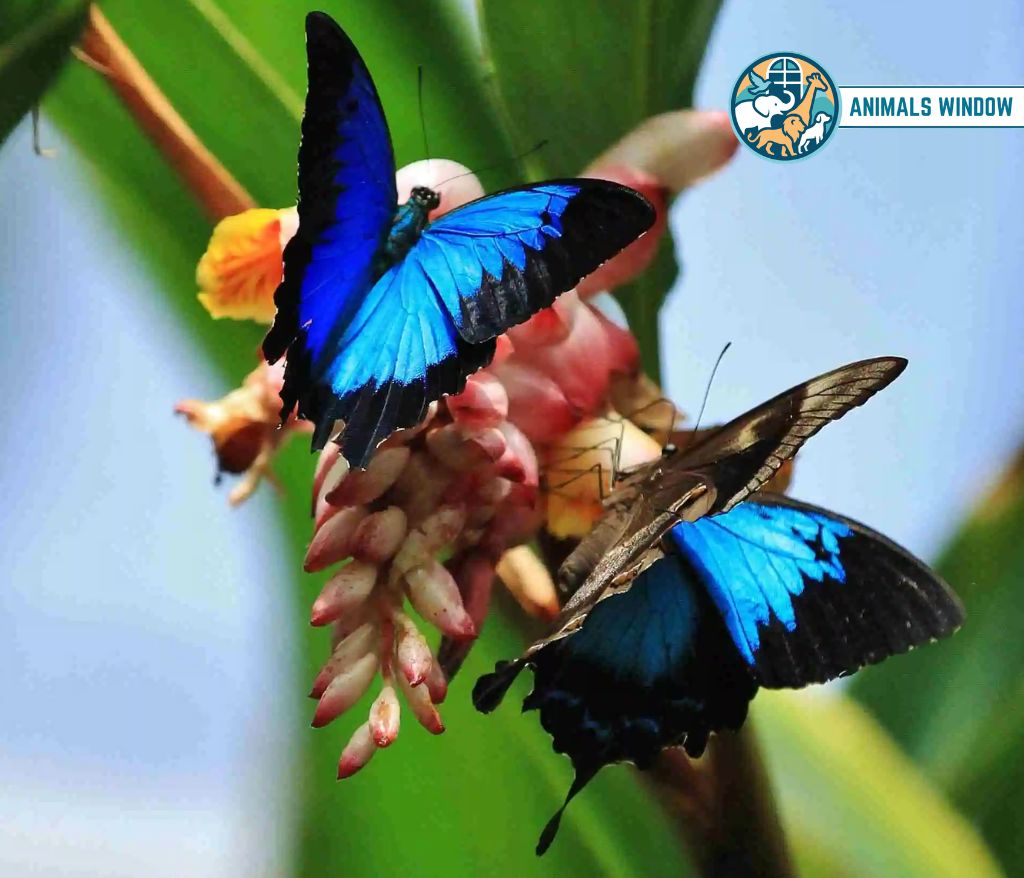
- Scientific Name: Papilio ulysses
- Size: Wingspan 10.5–14 cm
- Weight: Under 1 gram
- Diet: Adults: nectar; Caterpillars: melicope leaves
- Habitat: Rainforests of northern Australia, Papua New Guinea, nearby islands
- Lifespan: Adults live around 2–3 weeks
Seen from above, the Ulysses Butterfly is an electric, almost unreal sapphire blue. Seen from below, the wings fold to a brown-gray that disappears completely against bark and dead leaves. The shift happens in a half-second — open wings, gone. Closed wings, invisible.
The blue isn’t pigment. The wings are covered in microscopic ridges — like a diffraction grating — that separate white light and reflect only blue wavelengths back to the viewer. The same physics that makes soap bubbles iridescent. What makes Ulysses special is how saturated and consistent that blue is across the entire wing surface — a precision that engineers have studied for applications in anti-counterfeiting materials.
🔥 Comparison Fact: The wingspan is roughly the size of a standard playing card turned sideways — and the color is physically identical to the way light bends through a prism.
17. Steel Blue Ladybird
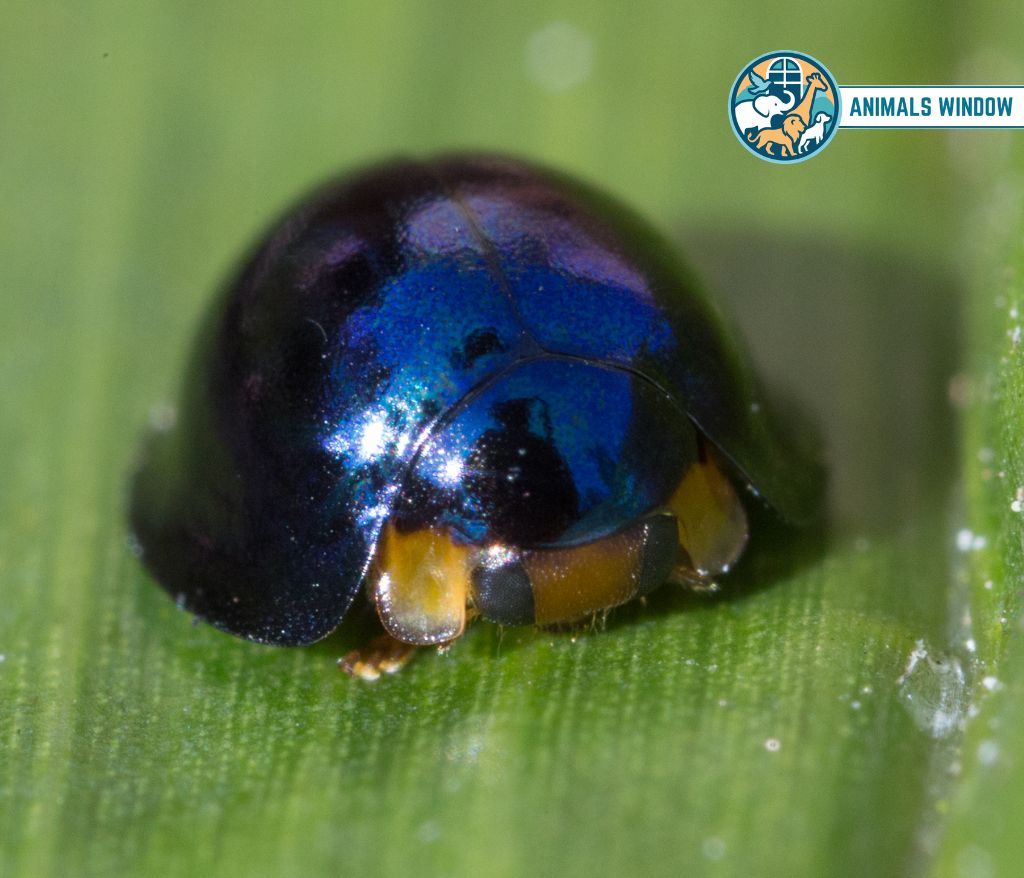
- Scientific Name: Halmus chalybeus
- Size: 4–5 mm
- Weight: Negligible (milligrams)
- Diet: Scale insects, mites, aphids, small soft-bodied pests
- Habitat: Gardens, orchards, forests — Australia, New Zealand
- Lifespan: Up to 1 year
Most people picture ladybirds as red with black spots. The Steel Blue Ladybird is a polished, deep metallic blue — small and round and almost jewel-like. It was deliberately introduced to New Zealand from Australia in the early 1900s to control scale insects devastating fruit orchards. It worked. It’s one of the most successful biological pest control programs in the Southern Hemisphere.
Unlike red ladybirds that broadcast their toxicity through bright warning colors, the Steel Blue Ladybird’s defense is more subtle — it secretes an unpleasant fluid from leg joints when threatened, a reflex called reflex bleeding. Predators learn quickly that small shiny blue beetles taste unpleasant.
🔥 Comparison Fact: Smaller than a watermelon seed, this beetle helped save millions of dollars in fruit crops across New Zealand every year.
18. Russian Blue Cat
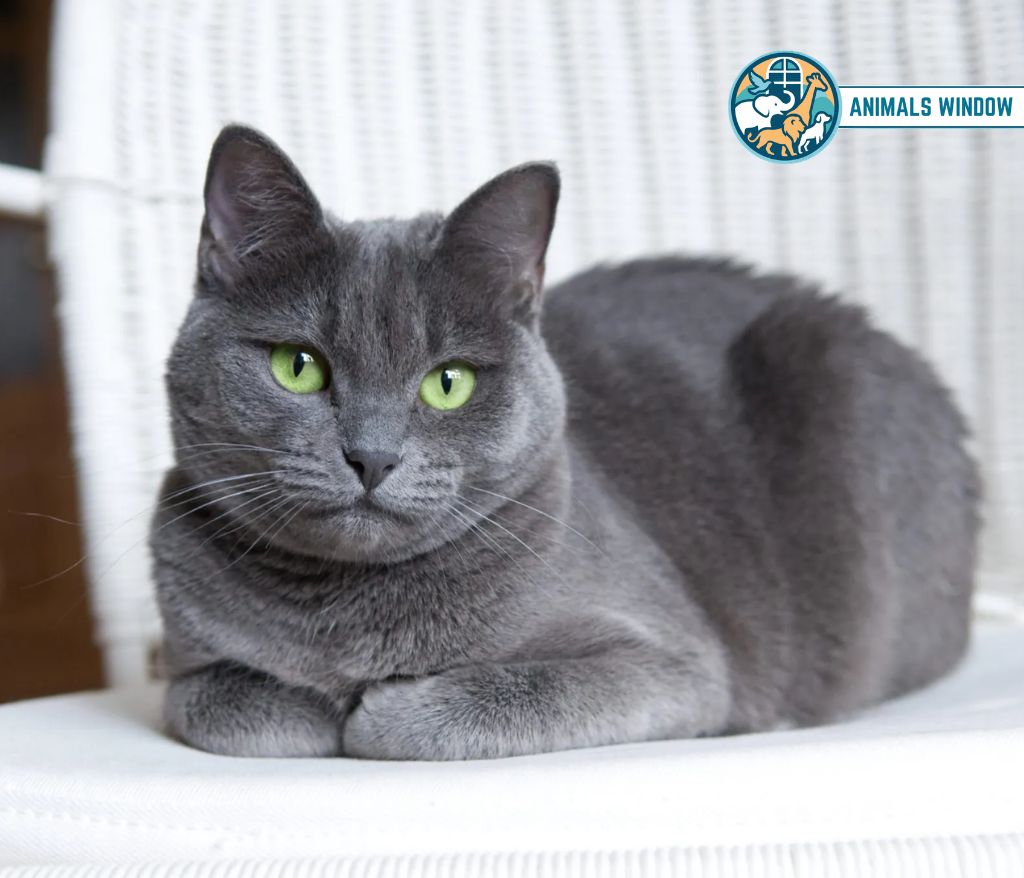
- Scientific Name: Felis catus
- Size: 25 cm height; 46–51 cm body length
- Weight: 3.5–7 kg
- Diet: High-protein diet — meat-based
- Habitat: Domestic; originated in Arkhangelsk, Russia
- Lifespan: 15–20 years
The Russian Blue’s coat isn’t actually blue. It’s a very dense, pale gray — but each individual hair has a silver-tipped end that catches light in a way that creates a blue sheen under certain lighting conditions. Cat breeders classify this dilute gray color specifically as “blue” in technical breed terminology, and it’s caused by a recessive gene that reduces the amount of black pigment (eumelanin) in each hair shaft.
What separates the Russian Blue from most domestic cats is coat density. Its double-layered coat is so thick it maintains a distinct shape — you can draw patterns in it and they hold. This double coat was likely an adaptation to survive subarctic winters in northern Russia, where the breed’s ancestors are believed to have lived.
🔥 Comparison Fact: The Russian Blue’s coat has twice the hair follicles per square centimeter as most other domestic cat breeds.
19. Humphead Wrasse
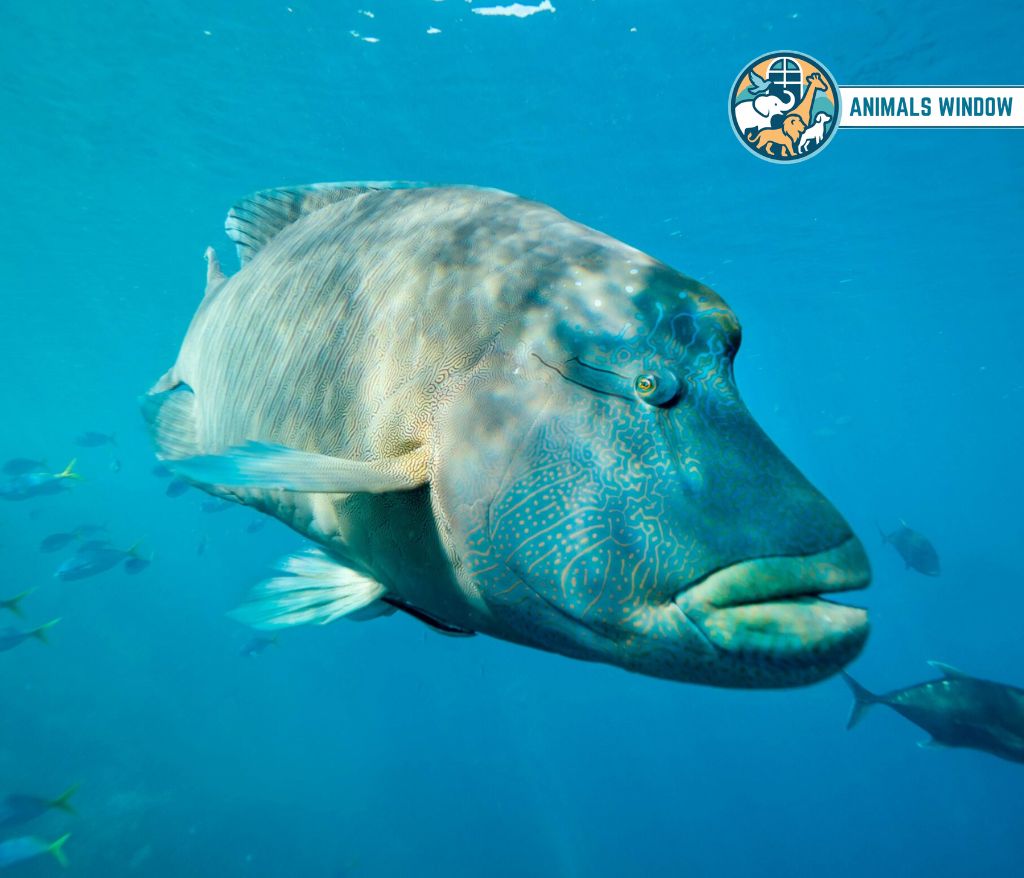
- Scientific Name: Cheilinus undulatus
- Size: Up to 230 cm
- Weight: Up to 191 kg
- Diet: Hard-shelled invertebrates, sea urchins, crabs, mollusks
- Habitat: Coral reef slopes — Indo-Pacific
- Lifespan: Up to 30 years
The Humphead Wrasse is a massive, blue-green fish with thick lips, a pronounced forehead hump, and a slow, stately movement through the water. It’s one of the largest reef fish in the world. The hump on its forehead gets bigger as the fish ages, eventually becoming the most recognizable part of its face.
It eats things most reef fish avoid — crown-of-thorns starfish, toxic sea urchins, and hard-shelled mollusks that would break a smaller fish’s teeth. And like many wrasses, if the dominant female in a group dies or disappears, the largest remaining female can transition into a male, complete with functioning reproductive anatomy. The change can take weeks.
🔥 Comparison Fact: A full-grown Humphead Wrasse weighs about as much as a baby grand piano leg — and its body can stretch longer than a standard doorway is tall.
20. Blue Coral Snake
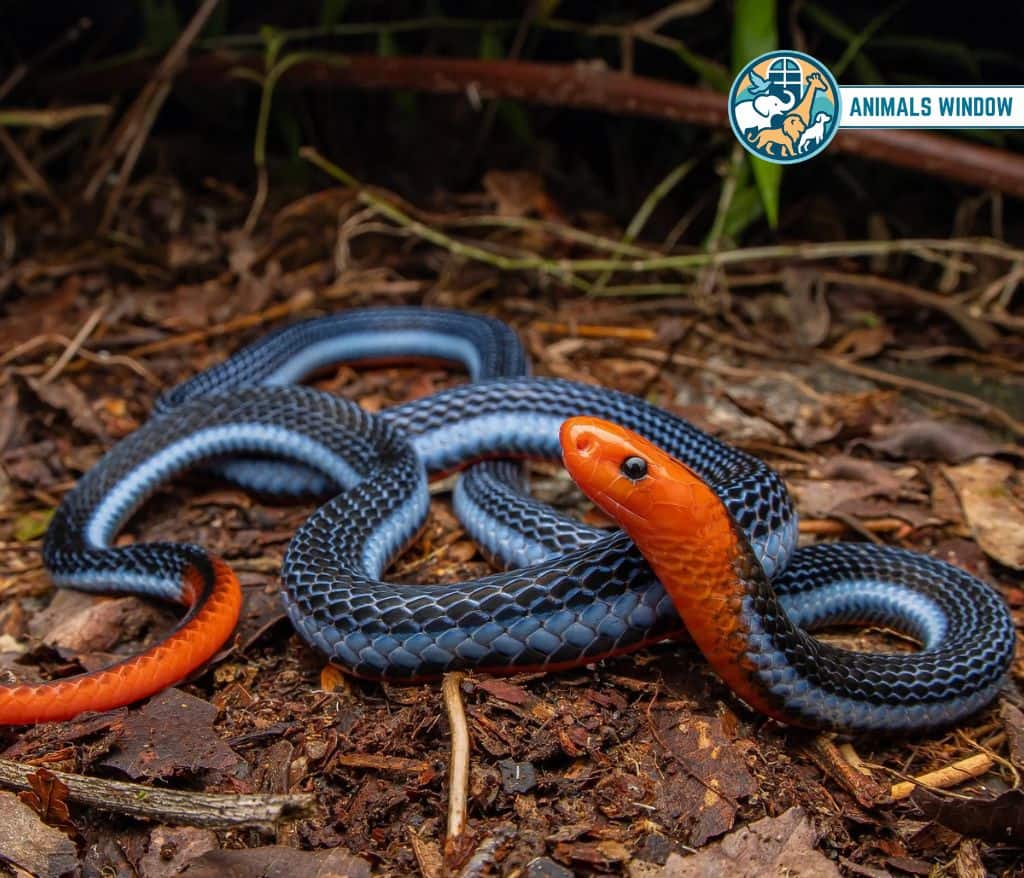
- Scientific Name: Calliophis bivirgata
- Size: 50–180 cm
- Weight: Up to 500 g
- Diet: Other snakes, skinks, elongated reptiles
- Habitat: Tropical lowland rainforests — Peninsular Malaysia, Sumatra, Borneo, Thailand
- Lifespan: Unknown; estimated 10–20 years
The Blue Coral Snake is deep navy blue on top and vivid red-orange on its head and underside. It hunts other snakes — including venomous ones — and is completely unbothered by their venom. What makes it genuinely different from most venomous snakes is how its venom works.
Most snake venoms either destroy tissue (cytotoxic) or stop blood from clotting (hemotoxic). The Blue Coral Snake’s venom is neither. It attacks the sodium channels in nerve cells, causing all muscles to contract simultaneously and uncontrollably — a response no other known snake venom triggers in quite the same way. Researchers studying it have described it as activating the entire nervous system at once. No prey survives, and the mechanism has attracted attention from scientists looking at pain receptor research.
🔥 Comparison Fact: About as long as a baseball bat at minimum — but its venom targets a nerve mechanism that no other currently known snake uses.
FAQ’s Related to Blue Animals
Why are blue animals so rare?
Blue pigment is almost impossible for living organisms to produce chemically. Most animals that appear blue use nanostructures in their skin or feathers to scatter light, the same way the sky looks blue. It’s a physical trick, not a chemical one.
What is the most venomous blue animal?
The blue-ringed octopus family holds this title. A single individual carries enough tetrodotoxin to kill 26 adult humans, and there is no antivenom available anywhere in the world.
Are there any completely blue mammals?
Not truly blue ones. The Russian Blue Cat appears blue due to light reflection on its gray-dilute coat. No wild mammal produces a naturally blue coat in the way birds or reptiles produce blue skin.
Can blue animals change their color?
Some can. The Sinai Agama male switches from brown to electric blue during mating season. The Blue Iguana’s blue intensifies in sunlight and fades in shade. The Blue-ringed Octopus switches its rings on and off in under a second.
What blue animal is the most endangered?
The Spix’s Macaw is functionally extinct in the wild, with only around 160–180 individuals surviving in captivity. The Blue Iguana is also critically endangered, with a wild population under 1,000 on a single island.
Related Animals Guides:
- Top 30 Skinny Animals in the World (With Pictures & Unique Facts)
- 25 Animals That Gallop (With Pictures and Unique Facts)
- Top 20 Animals Without Tails (With Pictures and Unique Facts)
Trait Comparison: Structural Color vs True Pigment
Most blue animals on this list use structural color — microscopic ridges, prisms, or nanostructures that bounce and scatter specific light wavelengths. The Ulysses Butterfly, Russian Blue Cat, and Blue Iguana all fall into this category. No chemical pigment exists. Crush the feather or scale, and the blue disappears.
True blue pigment is chemically different. The animal produces an actual molecule that absorbs all other wavelengths and reflects blue. The Mandarin Dragonet is the only known vertebrate to do this — it makes a pigment called cyanophore that exists nowhere else in the vertebrate world.
Why does the difference matter? Structural color can be brighter and more iridescent — it changes with viewing angle, which is why a butterfly wing shifts as it moves. True pigment is stable and consistent regardless of angle. Both are rare. But only one of them survives being ground up in a mortar.
Human engineers have been studying structural color for years — for anti-counterfeiting measures, reflective displays, and even cooling fabrics. The Ulysses Butterfly and the Mandarin Dragonet sit at the center of that research, each showing a different solution to the same problem: how to make the color blue when chemistry gives you almost nothing to work with.

I have loved animals since I was a kid. I enjoy reading about how animals live, eat, move, and survive. I started Animals Window to share what I learn in a simple and easy way. I write about animal body parts, size, behavior, diet, habitats, and species. My goal is to make animal facts clear and fun for everyone to understand.